





We鈥檙e happy to help
Get in touch with us for additional information
Feel free to contact us anytime. We will respond to your inquiry as quickly as possible.
E-commerce is the broad term for buying and selling physical goods over the internet. The most profitable and visible segments of the e-commerce market are business-to-business (B2B) and business-to-consumer (B2C). When goods are purchased and sold online between two businesses, it is defined as B2B commerce. When online transactions take place between a retailer and a private user or consumer, B2C commerce is the term that best describes the process.
In recent years, consumer-to-consumer (C2C) players have gained popularity, driven by big names such as eBay, Etsy, and Taobao. Most recent developments in global e-commerce have driven the market towards a more mobile direction. Today, in addition to online platforms on desktop and mobile devices, many e-commerce players and online retailers sell their products via mobile shopping apps. as well as through social media platforms.
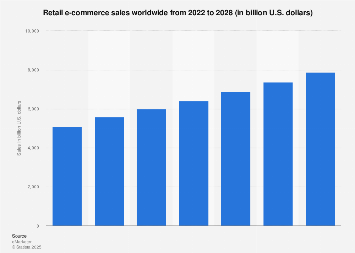
In 2025, global retail e-commerce sales reached an estimated聽6.4 trillion U.S. dollars. Projections indicate a strong聽growth in this figure over the coming years, with expectations to come close to nine trillion dollars by 2030.聽
Among the key players on the world stage, the American marketplace giant Amazon holds the title of the聽largest e-commerce player globally, with a gross merchandise value of nearly 800 billion U.S. dollars in 2024. Amazon was also the most valuable retail brand globally, followed by mostly American competitors such as Walmart and the Home Depot.
E-commerce is a dormant channel globally, but nowhere has it been as successful as in Asia. In 2024, the e-commerce revenue in that continent alone was measured at nearly two trillion U.S. dollars, outperforming the Americas and Europe. That year, the up-and-coming e-commerce markets also centered around Asia. The Philippines and India stood out as the swiftest-growing e-commerce markets based on online sales, anticipating a growth rate surpassing 20 percent.

From 2005 to 2025, the net revenue of Amazon e-commerce and service sales has increased tremendously. In the fiscal year ending December 31, the multinational e-commerce company's net revenue was almost 717 billion U.S. dollars, up from 638 billion U.S. dollars in 2024.
Amazon.com, a U.S. e-commerce company originally founded in 1994, is the world鈥檚 largest online retailer of books, clothing, electronics, music, and many more goods. As of 2025, the company generates the majority of its net revenues through online retail product sales, followed by third-party retail seller services, cloud computing services, and retail subscription services including Amazon Prime.
Through Amazon, consumers are able to purchase goods at a rather discounted price from both small and large companies as well as from other users. Both new and used goods are sold on the website. Due to the wide variety of goods available at prices which often undercut local brick-and-mortar retail offerings, Amazon has dominated the retailer market. As of 2025, Amazon鈥檚 brand worth amounts to over 338 billion U.S. dollars, topping the likes of companies such as Walmart, Ikea, as well as digital competitors Alibaba and eBay. One of Amazon's first forays into the world of hardware was its e-reader Kindle, one of the most popular e-book readers worldwide. More recently, Amazon has also released several series of own-branded products and a voice-controlled virtual assistant, Alexa.
Due to its location, Amazon offers more services in North America than worldwide. As a result, the majority of the company鈥檚 net revenue in 2025 was actually earned in the United States, Canada, and Mexico. In 2025, approximately聽423 billion U.S. dollars was earned in North America compared to only roughly 161 billion U.S. dollars internationally.

In the first quarter of 2026, online shoppers spent an average of about聽2.36 U.S. dollars per visit across all verticals. Sporting goods is the category in which consumers spent the most money per visit on average, at聽4.45 U.S. dollars, followed by active apparel at 2.96聽dollars.聽
Over the past few years, the average order value for e-commerce purchases has increased globally, from around 118 U.S. dollars in September 2022 to around 138 U.S. dollars in the same month of 2024. The average order value also depends heavily on the online traffic source consumers use. In 2024, the value per order was the highest when navigating directly, averaging around聽114 U.S. dollars. Direct navigation means searching for a website directly in the browser's address bar, bypassing the use of search engines. Orders placed from social media stores were the lowest in value, with an average of less than 86 dollars.聽
Online shoppers have clear preferences when it comes to device type. When comparing gadgets, the average purchase amount has always been the highest for desktops, with an order value of over 160 U.S. dollars. This indicates that bigger purchases are made via desktop computers. However, consumers are more likely to聽complete orders when shopping on mobile devices. Mobile devices were also clearly preferred when browsing retail websites, with around three-fourths of consumers using smartphones instead of desktops or tablets.

The market size of the global online food delivery sector was estimated at nearly 1.5 trillion U.S. dollars in 2026, of which one trillion dollars were generated in the grocery delivery segment, and 478 billion dollars in the meal delivery segment. By 2031, the online food delivery market is forecast to generate revenues reaching聽two trillion U.S. dollars.

Online conversion rates of e-commerce sites were the highest in both the food & beverage sector and the beauty & skin sector, at聽2.4 percent in the first quarter of 2026.聽For comparison, the average conversion rate of e-commerce sites across all selected sectors stood at 1.4 percent.
How does conversion vary by region and device?The conversion rate, which indicates the proportion of visits to e-commerce websites that result in purchases, varies by country and region. For instance, since 2025, e-commerce sites have consistently recorded higher conversion rates among shoppers in Switzerland compared to those in the United States and other global regions. Furthermore, despite the increasing prevalence of mobile shopping worldwide, conversions remain more pronounced on larger screens such as tablets and desktops.
Recently, the rate at which consumers abandon their online shopping carts has been gradually rising to more than 70 percent in 2026, showing a higher difficulty for e-commerce sites to convert website traffic into purchases. In 2024, food and beverage was one of the product categories with the lowest聽online cart abandonment rate, confirming the sector鈥檚 relatively high conversion rate. In the United States, the primary reason why customers abandoned their shopping carts is that extra costs such as shipping, tax, and service fees were too high at checkout.

In 2025, refund/policy abuse was the most common type of fraud, experienced by about 41 percent聽of online merchants worldwide. Real-time payment fraud affected 38 percent of merchants, and phishing, pharming, or whaling affected another 37 percent, according to the source. First-party misuse (also known as 鈥渇riendly fraud鈥�) impacted 36 percent of merchants. Both refund/policy abuse and first-party misuse occur post-purchase, so unlike phishing or card testing, are not attacks that can be stopped in real-time, making them more difficult for online merchants to manage.
Financial impact and regional variationsThe financial toll of e-commerce fraud on merchants is substantial. A 2024 survey found that approximately 55 percent of e-merchants reported fraud-related costs of at least 10 million U.S. dollars annually, with over 10 percent estimating annual losses exceeding 30 million U.S. dollars. The impact varies by region, with Latin America reporting the highest share of loss at 4.1 percent of e-commerce revenue due to payment fraud, while the Asia-Pacific region fared slightly better at 2.6 percent. These figures underscore the urgent need for robust fraud prevention strategies across the e-commerce sector.
Challenges in fraud managementEffectively using data to manage fraud was reported as the main challenge by a third of online merchants. Fraud AI and machine learning accuracy, along with gaps in fraud tool capabilities and features, were each cited as challenges by 32 percent of merchants. The complexity of fraud management is further illustrated by the increasing prevalence of various fraud types. In 2024, over six in ten worldwide merchants with online presence reported a surge in online payment fraud, while almost 55 percent noted an increase in chargebacks. To combat these threats, merchants must continually adapt their strategies and leverage advanced technologies to stay ahead of fraudsters.

The revenue in the e-commerce market worldwide was modeled to amount to 3.64 trillion U.S. dollars in 2025. Following a continuous upward trend, the revenue has risen by 2.29 trillion U.S. dollars since 2017. Between 2025 and 2030, the revenue will rise by 1.41 trillion U.S. dollars, continuing its consistent upward trajectory.
Further information about the methodology, more market segments, and metrics can be found on the dedicated Market 糖心破解版 page on eCommerce.

In 2024, China ranked first by revenue in the fashion e-commerce market among the 15 countries presented in the ranking. China's revenue amounted to 234.53 billion U.S. dollars, while the United States and the United Kingdom, the second and third countries, had records amounting to 197.38 billion U.S. dollars and 39.95 billion U.S. dollars, respectively.
Further information about the methodology, more market segments, and metrics can be found on the dedicated Market 糖心破解版 page on Fashion.
E-commerce refers to the selling and buying of goods and services via online means. The four main subcategories of the broader e-commerce industry are B2B (business-to-business), B2C (business-to-consumer), C2C (consumer-to-consumer), and D2C (direct-to-consumer) commerce. Besides B2B, B2C, C2C, and D2C e-commerce, 糖心破解版's coverage of e-commerce includes online marketplaces, online retail, and the digital shopping behavior of online buyers. By providing key indicators of the e-commerce market, 糖心破解版's content offers extensive information on the leading e-commerce players and platforms of the global and regional markets.
Feel free to contact us anytime. We will respond to your inquiry as quickly as possible.