


We鈥檙e happy to help
Get in touch with us for additional information
Feel free to contact us anytime. We will respond to your inquiry as quickly as possible.
Economy and politics are two topics that are strongly interconnected. The decisions made by political bodies have an influence on the economy of a nation, and how well the economy is doing is usually seen as a direct reflection of political policies and the success of the government in power. Gross Domestic Product (GDP) is seen as an indicator as to how strong a nation is, employment figures indicate the health of an economy, and national elections can influence the growth of a country for years to come. The Economy and Politics industry covers all manner of topics, such as unemployment, GDP, government finances and employment, and policy.

In 2026, Liechtenstein had the highest gross domestic product per capita in the world at just over 226,800 U.S. dollars. The top five largest economies in terms of GDP per capita were all in Europe, with Singapore having the largest GDP per capita in the rest of the world.听
Where GDP per capita correlatesAlthough not a perfect metric, economies with a high GDP per capita generally have some of the best living standards in the world. Life expectancy is often high, the population is usually聽better educated, and infant mortality tends to be low. In countries with high levels of income inequality, however, GDP per capita becomes much less effective at measuring overall affluence. Other indicators, such as the Human Development Index, attempt to compensate for this by taking a broader set of measurements into account to measure outcomes.听
U.S. remains the world's largest economy in 2026In 2026, the GDP of the United States amounted to approximately 32.4 trillion U.S. dollars, by far the largest economy in the world. Despite China's rapid economic growth in recent decades, it remained the world's second-largest economy, at 20.8 trillion dollars. When adjustments for purchasing power parity (PPP) are made, however, China has already overtaken the U.S. as the largest economy, with an adjusted GDP figure of 44.3 trillion dollars.听

In 2025, South Africa ranked first by unemployment rate among the 17 countries presented in the ranking. South Africa's rate amounted to 32.35 percent, while Turkey and France, the second and third countries, had records amounting to 8.30 percent and 7.61 percent, respectively.
This indicator describes the unemployment rate, which can be defined by either the national definition, the ILO harmonized definition, or the OECD harmonized definition. The latter defines it as the number of unemployed people divided by the total labor force.
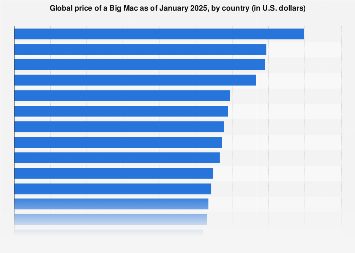
At 9.12 U.S. dollars, Switzerland has the most expensive Big Macs in the world, according to the January 2026 Big Mac index. Concurrently, the cost of a Big Mac was 6.12聽dollars in the U.S., and seven U.S. dollars in the Euro area.听
What is the Big Mac index?The Big Mac index, published by The Economist, is a novel way of measuring whether the market exchange rates for different countries鈥� currencies are overvalued or undervalued. It does this by measuring each currency against a common standard 鈥� the Big Mac hamburger sold by McDonald鈥檚 restaurants all over the world. Twice a year the Economist converts the average national price of a Big Mac into U.S. dollars using the exchange rate at that point in time. As a Big Mac is a completely standardized product across the world, the argument goes that it should have the same relative cost in every country. Differences in the cost of a Big Mac expressed as U.S. dollars therefore reflect differences in the purchasing power of each currency.
Purchasing power parity (PPP) is the idea that items should cost the same in different countries, based on the exchange rate at that time. This relationship does not hold in practice. Factors like tax rates, wage regulations, whether components need to be imported, and the level of market competition all contribute to price variations between countries. The Big Mac index does measure this basic point 鈥� that one U.S. dollar can buy more in some countries than others. There are more accurate ways to measure differences in PPP though, which convert a larger range of products into their dollar price. Adjusting for PPP can have a massive effect on how we understand a country鈥檚 economy. The country with the largest GDP adjusted for PPP is China, but when looking at the unadjusted GDP of different countries, the U.S. has the largest economy.

The United States led the ranking of the countries with the highest military spending in 2025, with 954 billion U.S. dollars dedicated to the military.听This amounted to 3.1聽percent of the U.S.'s gross domestic product (GDP), placing the country lower in the ranking of military expenditure as a percentage of GDP, compared to Ukraine, Israel, Algeria, Saudi Arabia, and Russia. China was the second largest military spender, with an estimated 336 billion U.S. dollars spent, with Russia following in third.听
Defense budget
According to the U.S. Congressional Budget Office, the outlays for defense will rise to 1.1 trillion U.S. dollars by 2033. The largest parts of the budget are dedicated to the聽Departments of the Navy and the Air Force. The budget for the U.S. Air Force for 2024 was nearly 260 billion U.S. dollars.
Global military spending
The value of military spending globally has grown steadily in recent years and reached 2.9聽trillion U.S. dollars in 2025. Reasons for this are the outbreak of the聽Russia-Ukraine war in 2022, the war in Gaza, and increasing tensions in the South China Sea. North America is by far the leading region worldwide in terms of expenditure on the military.

In August 2025, the public debt of the United States was around 37.27 trillion U.S. dollars, a slight decrease from the previous month. The U.S. public debt ceiling has become one of the most prominent political issues in the States in recent years, with debate over how to handle it causing political turmoil between Democrats and Republicans.
The public debt罢丑别听public debt of the United States has risen quickly since 2000, and in 2022 was more than five times higher than in 2000. The public debt is the total outstanding debt that is owed by the federal government. This figure comprises debt owed to the public (for example, through bonds) and intergovernmental debt (debt owed to various governmental departments), such as Social Security.
Debt in PoliticsThe debt issue has become a highly contentious topic within the U.S. government. Measures such as stimulus packages, social programs and tax cuts add to the public debt. Additionally, spending tends to peak during large global events, such as the Great Depression, the 2008 financial crisis, or the COVID-19 pandemic - all of which had a detrimental impact on the U.S. economy. Although both major political parties in the U.S. tend to blame one another for increases in the country's debt, a recent analysis found that both parties have contributed almost equally to national expenditure.
Debate on raising the debt ceiling, or the amount of debt the federal government is allowed to have at any one time, was a leading topic in the government shutdown in October 2013. Despite plans from both Democrats and Republicans on how to lower the national debt, it is only expected to increase over the next decade.

In 2026, the United States had the largest number of active military personnel out of all North Atlantic Treaty Organization (NATO) countries, with over 1.33 million troops. The country with the second-largest number of military personnel was Turkey, at around 481,000 active personnel. Additionally, the U.S. has by far the most armored vehicles in NATO, as well as the largest Navy and Air Force.听
NATO in brief
NATO, which was formed in 1949, is the most powerful military alliance in the world. At its formation, NATO began with 12 member countries, which by 2024 had increased to 32. NATO was originally formed to deter Soviet expansion into Europe, with member countries expected to come to each other鈥檚 defense in case of an attack. Member countries are also obliged to聽commit to spending two percent of their respective GDPs on defense, although many states have recently fallen far short of this target.听
NATO in the contemporary world
Some questioned the purpose of NATO after the fall of the Berlin Wall in 1989 and the collapse of the Soviet Union a few years later. In 2019, French President Emmanuel Macron even called the organization 'brain dead' amid dissatisfaction with the leadership of the U.S. during Donald Trump's first term. NATO has, however, seen a revival after Russia's聽invasion of Ukraine in February 2022. Following the invasion, Sweden and Finland abandoned decades of military neutrality and applied to join the alliance, with Finland joining in 2023 and Sweden in 2024.

According to the Hurun Global Rich List 2026, China housed the highest number of billionaires worldwide in 2026. In detail, there were 1,110 billionaires living in China as of January that year. By comparison, 1,000 billionaires resided in the United States. India, Germany, and the United Kingdom were also the homes of a significant number of billionaires that year.
The United States lost its first place to ChinaAs the founder and exporter of consumer capitalism, it is no surprise that the United States is home to a large number of billionaires. However, China has recently overtaken the U.S. Still,聽North America leads the way in terms of the highest number of ultra high net worth individuals 鈥� those with a net worth of more than fifty million U.S. dollars. The prominence of Europe and North America is a reflection of the higher degree of economic development in those states. However, this may also change as China and other emerging economies continue to develop.
Female billionairesMoreover, the small proportion of female billionaires does little to counter critics claiming the global economy is dominated by an elite comprised mainly of men. On the list of the richest people in the world, only two were women. Moreover, recent political discourse has put a great amount of attention on the wealth held by the super-rich, with the聽wealth distribution of the global population being heavily unequal.

In 2025, the United States government donated around 1.2 billion U.S. dollars in humanitarian aid worldwide. The European Commission and Germany followed with over 1.25 U.S. dollars. However, this only shows one part of the picture, as the largest economies are likely to be the largest donors. Another way of looking at the largest donors are by how much each country gave as a share of their gross domestic product.

In 2025, the average inflation rate worldwide stood at 4.13 percent. Between 1980 and 2025, the figure dropped by 13.12 percentage points, though the decline followed an uneven course rather than a steady trajectory. The inflation is forecast to decline by 0.93 percentage points from 2025 to 2031, fluctuating as it trends downward.
This indicator measures inflation based upon the year-on-year change in the average consumer price index, expressed in percent. The latter expresses a country's average level of prices based on a typical basket of consumer goods and services.
糖心破解版 offers a wide range of statistics and studies covering Economy & Politics. Under Economy, data covering business enterprise, employment, income and expenditure, international trade and treaties, key economic indicators, nonprofit organizations, as well as wages and salaries is offered. Concerning Politics & Government, 糖心破解版 covers areas including elections, government employment, government finance, national security, policy, and welfare. Finally, 糖心破解版 covers a wide range of International data, covering key economic indicators for more than 150 countries.
Feel free to contact us anytime. We will respond to your inquiry as quickly as possible.