Artificial intelligence (AI) investment, impact, and returns in the financial services sector - statistics & facts
Across the financial services industry, artificial intelligence (AI) has moved from a competitive differentiator to an operational baseline. As of 2025, 65 percent of financial services institutions reported actively deploying or using AI, with capital markets firms leading AI adoption at 68 percent. Generative AI (GenAI) accelerated this shift by lowering technical barriers; over 60 percent of financial services firms reported active use of GenAI in 2025, up from 52 percent in 2024. Investment has followed suit, with financial sector AI spending exceeding 75 billion U.S. dollars in 2026 and forecast to reach 125.13 billion U.S. dollars by 2028, at a compound annual growth rate of 29 percent.
AI investment in the banking sector
In the race for AI adoption, the banking sector has made noticeable headway. By the end of 2026, the banking sector's level of AI and GenAI investment was estimated to reach 53.14 billion U.S. dollars, growing at a compound annual growth rate of 30 percent and on track to exceed 90 billion U.S. dollars by 2028. This trend is expected to persist as聽banks continue to budget for AI spending; 70 percent of banking CEOs planned to direct between 10 and 20 percent of their budgets toward AI over the following 12 months.聽
Where AI delivers the strongest returns
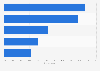
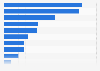
Budget priorities and actual returns tell a consistent story. AI investment priorities among financial service firms were centered on optimizing AI workflows and production cycles. These AI goals were reflected in the level of return on investment (ROI). The AI use cases with the largest overall ROI were front office-based, with document processing generating an overall return of 32 percent. Customer experience and engagement ranked second, followed by document management. These gains fed through to broader business outcomes. The primary impact of AI adoption was operational efficiencies, noted by over half of firms. Improved employee productivity was the second highest recorded impact of AI adoption.
Generated returns can be unevenly distributed
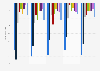
By early 2026, 40 percent of financial institutions reported that AI had increased their overall profitability, with 43 percent reporting no change and a single firm had reported a decline in profits. When reviewing the impact of AI on profitability by firm type, a starker contrast was visible. Over half of fintechs reported AI profitability, compared to roughly one-third of traditional financial institutions. The level of AI investment also displayed a notable contrast, as firms spending more than 100,000 U.S. dollars annually on AI reported gains at 61 percent, more than 20 percentage points ahead of lower-spending peers. Despite this variation, most banking leaders are optimistic about the timeline. Roughly 70 percent of banks expected to realize a return on their AI investment within one to three years. Just five percent of banks expect five or more years to generate an ROI.
Future forecast
AI is set to be the defining force in financial services through the remainder of the decade. As institutions move from early pilots to full-scale deployment, the strategic advantage will increasingly belong to those that have built proprietary AI capabilities rather than waiting for off the shelf soulations. The gap between early movers and late adopters is likely to widen as AI becomes further embedded in core operations, from risk management and compliance to client-facing services. Regulatory frameworks are expected to catch up with the pace of adoption, adding a new layer of complexity that institutions with mature AI governance structures will be better placed to manage. For the sector as a whole, the question is no longer whether AI delivers value, but how effectively each institution can capture it at scale.