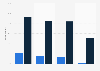
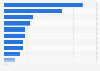
| Characteristic | Share of respondents |
|---|---|
| - | - |
| - | - |
| - | - |
| - | - |
| - | - |
| - | - |
| - | - |
| - | - |
| - | - |
| - | - |
| - | - |
| - | - |
The chart is not accessible to screen readers. Please switch to the table view to access the data.
January 2019
Worldwide
September 19 to October 4, 2018
2,229 respondents
large enterprises, small businesses, agencies and government and non-profit organizations
* Level 4 companies are the 12 percent of overall respondents who had the second-highest level of design adoption on a scale of one to five. The source labels these companies as 'Scientists', with a design philosophy that design is a hypothesis and an experiment. Organizations at this level are masters of data-driven design. They have sophisticated practices for analytics, experimentation, recruiting for user research, and monitoring and measuring the success of specific efforts. They also have the beginnings of a design strategy practice, engaging in market research and vision development. In these companies, the design team is empowered to pursue opportunities it deems important. Executives are all in, publicly declaring the importance of design, as well as measuring and monitoring its impact on the business. To support all of this, design operations are fully formalized.
Multiple answers were possible.
Original question: 鈥淥ur design team has had proven impact on: 鈥�