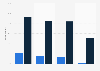
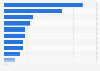
| Characteristic | Share of respondents |
|---|---|
| - | - |
| - | - |
| - | - |
| - | - |
| - | - |
| - | - |
| - | - |
| - | - |
| - | - |
| - | - |
| - | - |
| - | - |
The chart is not accessible to screen readers. Please switch to the table view to access the data.
January 2019
Worldwide
September 19 to October 4, 2018
2,229 respondents
large enterprises, small businesses, agencies and government and non-profit organizations
* Level 3 companies are the 21 percent of overall respondents who had the middle level of design adoption on a scale of one to five. The source labels these companies as 'Architects', with a design philosophy that design is a standardized scalable process. Formalizing design as a scalable function is a marquee trait for Level 3 businesses. They have moved beyond basic participatory design processes and have shared ownership, role clarity, joint accountability, and more documentation of their now more substantial design practices. This enables design to support more complex product ecosystems while integrating itself into equally complex internal operating structures.
Multiple answers were possible.
Original question: 鈥淥ur design team has had proven impact on: 鈥�