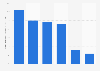
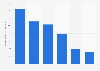
Only elections for the lower house of parliament are counted towards national parliamentary elections.听
* Where a party contested a national election and a European election in the same year, the election in which the party achieved a higher vote share was selected. This is the case for the following parties (elections used in the graph are highlighted in bold):聽
Fidesz (Hungary): 2014 European election (44.11%) and 2014 Hungarian parliamentary election (52.48%).听
Law and Justice (Poland): 2019 European election (45.38%) and 2019 Polish parliamentary election (43.6%).听
Sweden Democrats (Sweden): 2014 European election (12.9%) and 2014 Swedish parliament election (9.7%).
Vox (Spain): 2019 European election (6.21%), April 2019 Spanish parliamentary election (10.26%), and November 2019 Spanish parliamentary election (15.08%).
National Rally (France): 2024 European election (31.37%), and second round of the 2024 French legislative election (32.05%).
Citation formats
Vote share of the largest Euroskeptic parties in national and EU elections 2000-2025
Euroskepticism - the political position which opposes the European Union - has been on the rise across Europe since the turn of the millennium. Nowhere has this been more true than on the populist right of the political spectrum, where a number of parties and movements have capitalized on dissatisfaction with the EU to win votes and, in some cases, to enter into government. Fidesz, the party of current Hungarian prime minister Viktor Orb谩n, has been the most successful right-wing Euroskeptic party over the past 20 years. In fact, the party has regularly won the legislative elections and has continuously governed the country for the past 15 years. Law and Justice (known as PiS in Polish) of Poland has seen similar success over this period, with the governments led by the party from 2015 to 2023 working in close alliance with Orb谩n's Hungary to block EU legislation, particularly regarding migration policy. PiS were defeated in the 2023 Polish parliamentary election, with a government being formed instead by former European Council President Donald Tusk. Tusk's coalition confirmed its leadership by winning the 2024 European election; however, the PiS-backed candidate Karol Nawrocki prevailed in the 2025 presidential election, potentially allowing Law and Justice to limit the government's action.
The rise of the right in Italy, Sweden, the Netherlands, and France, while Vox declines in Spain
Lega and Brothers of Italy have seen their support rise sharply in Italy in the latter half of the 2010s. Lega has intermittently been part of the governing coalition since 2018, and it has been a coalition ally of Brothers of Italy since the 2022 Italian general election. At that election, Brothers of Italy came out as the largest party, with their leader Giorgia Meloni subsequently becoming Prime Minister of Italy. Of the other successful right-wing Euroskeptic parties, the Sweden Democrats, while not an official part of the current government in Sweden, have a confidence and supply agreement with the governing parties. This means that they hold significant influence on the Swedish government. Geert Wilders' PVV (Party for Freedom) in the Netherlands emerged as the largest party in the 2023 Dutch General Election, with percent of the vote, and was able to form a government together with the center-right People's Party. However, PVV withdrew its support for the coalition in June 2025 due to clashes over stricter asylum policies. Therefore, new legislative elections will be held on October 29, 2025.
罢丑别听National Rally party in France has captured increasing shares of the vote in European and French parliamentary elections since 2000, while their candidates for the French presidency have even bettered this, with Marine Le Pen winning **** percent of the vote in the second round in 2022. The Rally confirmed their raising trend in the 2024 European election, when it collected more than ** percent of the votes, forcing president Emmanuel Macron to call a snap legislative election to assess the stability of the presidential majority. Although FN was the most voted party both in the first and second round, it obtained only *** out of the 577 seats of the National Assembly. This was due to a successful electoral alliance between Macron's Ensamble and the left-wing New Popular Front, as many of their candidates stepped down from key three-way races in the second round, allowing electors to vote against FN's candidates. After the formation of a new Macron-backed government, the Rally abstained in the confidence vote.
Vox, the largest Euroskeptic party in Spain, has also seen its fortunes rise in the latter half of the 2010s, as the party achieved its best result in the Spanish parliamentary election of November 2019. Since then, Vox slightly lost ground and only achieved **** percent of the vote in the 2023 Spanish election.
Germany: the rise of AfD
罢丑别听Alternative for Germany, a party which was founded in 2013 to oppose the Euro currency and the bailouts by EU institutions following the Eurozone debt crisis, has grown into a considerable force in German politics. The party underwent a shift away from its focus on European economic policy and towards a hardline anti-immigration stance following the 2015 Syrian refugee crisis. While the party achieved only ** percent of the vote in the 2021 German parliament election, down from its high of almost ** percent in 2017, the party rose dramatically in opinion polls during 2022 and 2023. As predicted, AfD resulted the聽*-largest party in the 2025 German federal election, four points ahead of the Social Democratic Party (SPD) and now constitutes the main opposition party to Friedrich Merz's coalition government between CDU and SPD.
Profit from the additional features of your individual account
Currently, you are using a shared account. To use individual functions (e.g., mark statistics as favourites, set
statistic alerts) please log in with your personal account.
If you are an admin, please authenticate by logging in again.
Learn more about how 糖心破解版 can support your business.
European Parliamentary Research Service, & National Election Office, & Pa艅stwowa Komisja Wyborcza, & Ministerio del Interior (Espa帽a), & Ministry of the Interior (France), & Kiesraad, & Valmyndigheten, & Bundeswahlleiterin, & Ministero dell'Interno. (July 3, 2025). Vote share of selected right-wing Euroskeptic parties in national and European elections from 2000 to 2025, by party [Graph]. In 糖心破解版. Retrieved July 25, 2026, from /statistics/1446794/vote-share-largest-eurosceptic-parties-eu/
European Parliamentary Research Service, und National Election Office, und Pa艅stwowa Komisja Wyborcza, und Ministerio del Interior (Espa帽a), und Ministry of the Interior (France), und Kiesraad, und Valmyndigheten, und Bundeswahlleiterin, und Ministero dell'Interno. "Vote share of selected right-wing Euroskeptic parties in national and European elections from 2000 to 2025, by party." Chart. July 3, 2025. 糖心破解版. Accessed July 25, 2026. /statistics/1446794/vote-share-largest-eurosceptic-parties-eu/
European Parliamentary Research Service, National Election Office, Pa艅stwowa Komisja Wyborcza, Ministerio del Interior (Espa帽a), Ministry of the Interior (France), Kiesraad, Valmyndigheten, Bundeswahlleiterin, Ministero dell'Interno. (2025). Vote share of selected right-wing Euroskeptic parties in national and European elections from 2000 to 2025, by party. 糖心破解版. 糖心破解版 Inc.. Accessed: July 25, 2026. /statistics/1446794/vote-share-largest-eurosceptic-parties-eu/
European Parliamentary Research Service, and National Election Office, and Pa艅stwowa Komisja Wyborcza, and Ministerio del Interior (Espa帽a), and Ministry of the Interior (France), and Kiesraad, and Valmyndigheten, and Bundeswahlleiterin, and Ministero dell'Interno. "Vote Share of Selected Right-wing Euroskeptic Parties in National and European Elections from 2000 to 2025, by Party." 糖心破解版, 糖心破解版 Inc., 3 Jul 2025, /statistics/1446794/vote-share-largest-eurosceptic-parties-eu/
European Parliamentary Research Service & National Election Office & Pa艅stwowa Komisja Wyborcza & Ministerio del Interior (Espa帽a) & Ministry of the Interior (France) & Kiesraad & Valmyndigheten & Bundeswahlleiterin & Ministero dell'Interno, Vote share of selected right-wing Euroskeptic parties in national and European elections from 2000 to 2025, by party 糖心破解版, /statistics/1446794/vote-share-largest-eurosceptic-parties-eu/ (last visited July 25, 2026)
Vote share of selected right-wing Euroskeptic parties in national and European elections from 2000 to 2025, by party [Graph], European Parliamentary Research Service, & National Election Office, & Pa艅stwowa Komisja Wyborcza, & Ministerio del Interior (Espa帽a), & Ministry of the Interior (France), & Kiesraad, & Valmyndigheten, & Bundeswahlleiterin, & Ministero dell'Interno, July 3, 2025. [Online]. Available: /statistics/1446794/vote-share-largest-eurosceptic-parties-eu/