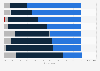
| Characteristic | Yes | No | Do not know | Refused |
|---|---|---|---|---|
| Estonia | 50% | 41% | 9% | 0% |
| Slovakia | 50% | 44% | 6% | 0% |
| Slovenia | 49% | 48% | 1% | 2% |
| Lithuania | 44% | 27% | 28% | 2% |
| Ukraine | 44% | 51% | 5% | 0% |
| Poland | 43% | 52% | 6% | 0% |
| Croatia | 42% | 46% | 11% | 0% |
| Latvia | 41% | 48% | 10% | 0% |
| Czechia | 38% | 53% | 9% | 0% |
| Romania | 37% | 50% | 13% | 0% |
| Russia | 37% | 61% | 2% | 0% |
| North Macedonia | 35% | 53% | 12% | 0% |
| Serbia | 35% | 48% | 16% | 1% |
| Albania | 34% | 52% | 14% | 0% |
| Montenegro | 33% | 50% | 16% | 0% |
| Bulgaria | 33% | 61% | 6% | 0% |
| Kosovo | 32% | 56% | 11% | 0% |
| Hungary | 30% | 61% | 9% | 0% |
| Bosnia and Herzegovina | 30% | 61% | 9% | 0% |
The chart is not accessible to screen readers. Please switch to the table view to access the data.
Loading statistic...
Download
Source
Source
Release date
May 2021
More information
Region
Central and Eastern Europe
Survey time period
2020
Supplementary notes
The original question was worded by the source as follows: "Vaccines are given to people to help prevent specific diseases. If a vaccine to prevent coronavirus was available right now at no cost, would you agree to be vaccinated?"
Survey methodology for each country can be accessed .
Citation formats