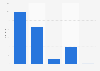
| Characteristic | Allies | Axis | Overseas colonies |
|---|---|---|---|
| Soviet Union | 21,176 | - | - |
| British dominions | - | - | 19,185 |
| British colonies | - | - | 14,994 |
| French colonies | - | - | 12,099 |
| China | 9,800 | - | - |
| United States | 7,856 | - | - |
| Italian colonies | - | - | 3,488 |
| Dutch colonies | - | - | 1,904 |
| Japanese colonies | - | - | 1,602 |
| France | 551 | - | - |
| Thailand | - | 518 | - |
| Germany | - | 470 | - |
| Poland | 389 | - | - |
| Finland | - | 383 | - |
| Japan | - | 382 | - |
| U.S. colonies | - | - | 324 |
| Norway | 323 | - | - |
| Italy | - | 310 | - |
| Romania | - | 295 | - |
| Yugoslavia | 248 | - | - |
| United Kingdom | 245 | - | - |
| Baltic states | 167 | - | - |
| Czechoslovakia | 140 | - | - |
| Greece | 130 | - | - |
| Hungary | - | 117 | - |
| Bulgaria | - | 103 | - |
| Austria | - | 84 | - |
| Denmark | 43 | - | - |
| Netherlands | 33 | - | - |
| Belgium | 30 | - | - |
The chart is not accessible to screen readers. Please switch to the table view to access the data.
Worldwide
1938
An additional figure of 6,430,000 sq. km is given for "Near East and North Africa".
All figures refer to 1938 boundaries. Individual notes as follows:
British colonies: includes joint Anglo-French and Anglo-Egyptian colonies. Refers to many present-day countries in the Middle East, Asia, the Caribbean, and Oceania.
British Dominions: Australia, Canada, Newfoundland and Labrador, New Zealand, Union of South Africa.
China: not including Manchuria.
French colonies: mainly in the Middle East, Africa, and Southeast Asia.
Germany: Geographical boundaries of the Treaty of Versailles. Not including Austria (annexed in March 1938), or the Sudetenland (annexed from Czechoslovakia in September 1938).
Italian colonies: mainly Libya and Abyssinia (Ethiopia).
Japanese colonies: Korea, Formosa (Taiwan), and Manchuria.
For several countries, affiliations to the Allied and Axis powers changed over the course of the war - for display purposes the categories chosen here are based on historical consensus and which side they spent most of the war fighting for.