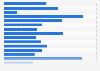
| Number of present-day countries | Characteristic |
|---|---|
| British** | 18.5 |
| French | 17.5 |
| German | 6 |
| Portuguese | 5 |
| Italian | 2.5 |
| Spanish | 1.5 |
| Belgian | 1 |
| Independent | 2 |
The chart is not accessible to screen readers. Please switch to the table view to access the data.
Africa
1914
Africa's current borders are not exactly the same as the borders of 1914, therefore there may have been some slight overlap between the European-administered regions. Only in cases where the countries were split significantly between two European countries; i.e. Somalia (British and Italian) and Morocco (French and Spanish), has each European nation been allocated 0.5.
*Data relates to the 54 UN member states located in Africa, and does not include overseas territories or disputed territories (Western Sahara included with Morocco).
**Egypt and Anglo-Egyptian Sudan (present-day Sudan and South Sudan) were nominally part of the Ottoman Empire, but were de facto parts of the British Empire.
The present-day countries under each European administration are as follows:
British: Botswana, Egypt, Eswatini, Gambia, Ghana, Kenya, Lesotho, Malawi, Mauritius, Nigeria, Seychelles, Sierra Leone, Somalia (split with Italy), South Africa, South Sudan, Sudan, Uganda, Zambia, Zimbabwe.
French: Algeria, Benin, Burkina Faso, Central African Republic, Chad, Comoros, C么te d'Ivoire, Djibouti, Gabon, Guinea, Madagascar, Mali, Mauritania, Morocco (split with Spain), Niger, Republic of the Congo, Senegal, Tunisia.
German: Burundi, Cameroon, Namibia, Rwanda, Tanzania, Togo.
Portuguese: Angola, Cabo Verde, Guinea-Bissau, Mozambique, 聽S茫o Tom茅 and Pr铆ncipe.
Italian: Eritrea, Libya, Somalia (split with Britain).
Spanish: Equatorial Guinea, Morocco (split with France).
Belgian: Democratic Republic of the Congo
Independent: Ethiopia, Liberia