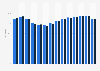
| Characteristic | Viewer share of total population |
|---|---|
| - | - |
| - | - |
| - | - |
| - | - |
| - | - |
| - | - |
| - | - |
| - | - |
| - | - |
| - | - |
| - | - |
| - | - |
| - | - |
| - | - |
| - | - |
| - | - |
| - | - |
| - | - |
| - | - |
| - | - |
| - | - |
| - | - |
| - | - |
| - | - |
| - | - |
| - | - |
| - | - |
| - | - |
| - | - |
| - | - |
| - | - |
| - | - |
| - | - |
| - | - |
| - | - |
| - | - |
| - | - |
The chart is not accessible to screen readers. Please switch to the table view to access the data.
Download
Source
More information
Region
Germany
Survey time period
1988 to 2024
Age group
14 years and older
Special properties
TV Scope, TV panel D+EU, all channels, Monday to Sunday, 03:00 to 03:00
Supplementary notes
* According to the source, the term viewer is defined as the potential viewers of a program with a minimun viewing time of one consecutive minute. Every person fulfilling the standard criteria, i.e. tunes in to the program and watches for at least on minute consecutively, is counted as a viewer of that particular program. In 1999, the AGF substituted the term "viewer" for the term "net reach".
1988 to 1991 West Germany; from 1992 Germany; from 2011 TV panel D+EU; from 2016 TV panel in German.
Citation formats