The question was phrased by the source as follows: "Vous personnellement, soutenez-vous le mouvement #MeToo (mouvement lanc茅 en 2017 encourageant la lib茅ration de la parole des femmes victimes d鈥檃gressions sexuelles et de viols) ?"
Citation formats
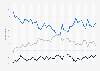
French support for the #Metoo movement 2022, by age and political proximity
Following the Weinstein scandal (former American film producer accused and then convicted of rape and sexual assault), in October 2017, actress Alyssa Milano relaunched the hashtag #MeToo, created ten years earlier by American feminist activist Tarana Burke. This hashtag then quickly became viral on social networks. Its French version - #balancetonporc - calls for breaking the omerta and generates testimonies ranging from daily sexism and street harassment to sexual assault and rape.
In 2022, the #Metoo movement was supported by a majority of French people (** percent), especially among those under ** (** percent). However, this support varied according to the political proximity of the French. Indeed, among the general population, supporters of left-wing political parties were more likely to support the movement than those of right-wing parties, although the gap was relatively small. In contrast, only ** percent of supporters of Eric Zemmour's party supported the movement, which is not very surprising given the sexism and accusations of sexual assault targeting the founder of the Reconqu锚te party. His supporters under the age of **, however, were nearly **** in support of #Metoo.
While #Metoo has had some repercussions on the judicial system, the reception of victims' voices and the treatment of cases of gender-based and sexual violence by representatives of this system is still deficient. In 2020, nearly **** of cases of sexual violence were closed without prosecution. Moreover in 2021, only **** of women who filed a complaint for domestic and sexual violence reported a positive treatment from the authorities. Indeed, the victims are frequently confronted with a trivialization of the facts by the police officers in charge of the complaint, with guilt-inducing attitudes, with mockery, or even with an outright refusal to register the complaint. And yet, in France, the receipt of complaints is a legal obligation for police officers. In terms of proportions, the number of female victims who file a complaint thus remains low, although younger women are more likely to do so.
Profit from the additional features of your individual account
Currently, you are using a shared account. To use individual functions (e.g., mark statistics as favourites, set
statistic alerts) please log in with your personal account.
If you are an admin, please authenticate by logging in again.
Learn more about how 糖心破解版 can support your business.
IFOP. (September 22, 2022). Support for the #Metoo movement in France in 2022, by political proximity and age [Graph]. In 糖心破解版. Retrieved July 25, 2026, from /statistics/1336379/french-support-metoo-movement-political-proximity-age/
IFOP. "Support for the #Metoo movement in France in 2022, by political proximity and age." Chart. September 22, 2022. 糖心破解版. Accessed July 25, 2026. /statistics/1336379/french-support-metoo-movement-political-proximity-age/
IFOP. (2022). Support for the #Metoo movement in France in 2022, by political proximity and age. 糖心破解版. 糖心破解版 Inc.. Accessed: July 25, 2026. /statistics/1336379/french-support-metoo-movement-political-proximity-age/
IFOP. "Support for The #metoo Movement in France in 2022, by Political Proximity and Age." 糖心破解版, 糖心破解版 Inc., 22 Sep 2022, /statistics/1336379/french-support-metoo-movement-political-proximity-age/
IFOP, Support for the #Metoo movement in France in 2022, by political proximity and age 糖心破解版, /statistics/1336379/french-support-metoo-movement-political-proximity-age/ (last visited July 25, 2026)
Support for the #Metoo movement in France in 2022, by political proximity and age [Graph], IFOP, September 22, 2022. [Online]. Available: /statistics/1336379/french-support-metoo-movement-political-proximity-age/