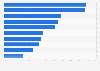
| Characteristic | Completely agree | Mostly agree | Mostly disagree | Completely disagree | Not sure, not specified |
|---|---|---|---|---|---|
| 鈥濬ake news鈥� can lead to the discrimination of individual persons | 58.2% | 31.7% | 4.8% | 0.7% | 4.6% |
| 鈥濬ake news鈥� can lead to the discrimination of groups | 54.1% | 34.7% | 5.2% | 1.3% | 4.8% |
| Elections can be influenced through 鈥瀎ake news鈥� | 43.6% | 39.6% | 8.6% | 2.1% | 6% |
| News can be difficult to trust because of 鈥瀎ake news鈥� | 46.9% | 37.6% | 9% | 1.5% | 5% |
| Populists gain aproval due to 鈥瀎ake news鈥� | 39.6% | 36.8% | 10.2% | 3.7% | 9.8% |
| 鈥濬ake news鈥� contributes to the spread of conspiracy theories | 42.9% | 40.4% | 8.1% | 1.8% | 6.7% |
The chart is not accessible to screen readers. Please switch to the table view to access the data.
Loading statistic...
Download
Source
Source
Release date
March 2017
More information
Region
Germany
Survey time period
February 28 to March 3, 2017
Number of respondents
1,017 respondents
Age group
18 years and older
Method of interview
Online survey
Citation formats