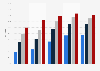
| Characteristic | In person | Partially open* | Remote | Academic break |
|---|---|---|---|---|
| - | - | - | - | - |
| - | - | - | - | - |
| - | - | - | - | - |
| - | - | - | - | - |
| - | - | - | - | - |
| - | - | - | - | - |
| - | - | - | - | - |
The chart is not accessible to screen readers. Please switch to the table view to access the data.
Download
Source
Sources
In cooperation with
McKinsey & Company
Release date
April 2022
More information
Region
Worldwide
Survey time period
Feburary 16 2020 to January 31 2022
Special properties
102 weeks in total
Supplementary notes
* In the United States, partially open meant that schools were partially teaching in person and partially remotely. In other countries, partially open meant that schools were either open in some areas and closed in others, open for specific grades or age groups, and/or using a hybrid learning regime, i.e. combining in-person and remote learning.
** McKinsey used Burbio as a source for the U.S. school closures.
Citation formats