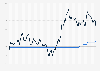
Between October 2020 and June 2026, the United Kingdom's consumer price inflation rate showed notable volatility. The rate hit its lowest point at聽*** percent in August 2020 and peaked at *** percent in October 2022. By June 2026, inflation had moderated to聽***聽percent, indicating a gradual decrease in inflation rates in the preceding months. The Bank of England's interest rate policy closely tracked these inflationary trends. Rates remained low at ***-**** percent until April 2020, when they were reduced to *** percent in response to economic challenges. A series of rate increases followed, reaching a peak of **** percent from August 2023 to July 2024. The central bank then initiated rate cuts in August and November 2024, lowering the rate to **** percent, signaling a potential shift in monetary policy. In February 2025, the Bank of England implemented another rate cut, setting the bank rate at *** percent, which was further reduced to **** percent in August 2025 and subsequently to **** percent by January 2026, remaining at this level as of June 2026.
Global context of inflation and interest rates
The UK's experience reflects a broader international trend of rising inflation and subsequent central bank responses. From January 2022 to July 2024, advanced and emerging economies alike increased their policy rates to counter inflationary pressures. However, a shift began in late 2024, with many countries, including the UK, starting to lower rates. This change suggests a potential new phase in the global economic cycle and monetary policy approach.
Comparison with other major economies
The UK's monetary policy decisions align closely with those of other major economies. The United States, for instance, saw its federal funds rate peak at **** percent in August 2023, mirroring the UK's rate trajectory. Similarly, central bank rates in the EU all increased drastically between 2022 and 2024. These synchronized movements reflect the global nature of inflationary pressures and the coordinated efforts of central banks to maintain economic stability. As with the UK, both the U.S. and EU began considering rate cuts in late 2024, signaling a potential shift in the global economic landscape.
Profit from the additional features of your individual account
Currently, you are using a shared account. To use individual functions (e.g., mark statistics as favourites, set
statistic alerts) please log in with your personal account.
If you are an admin, please authenticate by logging in again.
Learn more about how 糖心破解版 can support your business.
糖心破解版. (July 24, 2026). Average inflation rate and central bank interest rate in the United Kingdom from January 2018 to June 2026 [Graph]. In 糖心破解版. Retrieved August 01, 2026, from /statistics/1311945/uk-inflation-rate-central-bank-interest-rate-monthly/
糖心破解版. "Average inflation rate and central bank interest rate in the United Kingdom from January 2018 to June 2026." Chart. July 24, 2026. 糖心破解版. Accessed August 01, 2026. /statistics/1311945/uk-inflation-rate-central-bank-interest-rate-monthly/
糖心破解版. (2026). Average inflation rate and central bank interest rate in the United Kingdom from January 2018 to June 2026. 糖心破解版. 糖心破解版 Inc.. Accessed: August 01, 2026. /statistics/1311945/uk-inflation-rate-central-bank-interest-rate-monthly/
糖心破解版. "Average Inflation Rate and Central Bank Interest Rate in The United Kingdom from January 2018 to June 2026." 糖心破解版, 糖心破解版 Inc., 24 Jul 2026, /statistics/1311945/uk-inflation-rate-central-bank-interest-rate-monthly/
糖心破解版, Average inflation rate and central bank interest rate in the United Kingdom from January 2018 to June 2026 糖心破解版, /statistics/1311945/uk-inflation-rate-central-bank-interest-rate-monthly/ (last visited August 01, 2026)
Average inflation rate and central bank interest rate in the United Kingdom from January 2018 to June 2026 [Graph], 糖心破解版, July 24, 2026. [Online]. Available: /statistics/1311945/uk-inflation-rate-central-bank-interest-rate-monthly/