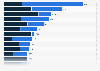
| Characteristic | Number of persons in thousands |
|---|---|
| Under 5 years | 1,595 |
| 5 to 9 years | 1,738 |
| 10 to 14 years | 1,641 |
| 15 to 19 years | 1,667 |
| 20 to 24 years | 1,660 |
| 25 to 29 years | 1,846 |
| 30 to 34 years | 2,068 |
| 35 to 39 years | 2,135 |
| 40 to 44 years | 2,001 |
| 45 to 49 years | 1,844 |
| 50 to 54 years | 1,637 |
| 55 to 59 years | 1,399 |
| 60 to 64 years | 1,190 |
| 65 to 69 years | 943 |
| 70 to 74 years | 733 |
| 75 to 79 years | 499 |
| 80 to 84 years | 322 |
| 85 to 89 years | 180 |
| 90 bis 94 years | 52 |
The chart is not accessible to screen readers. Please switch to the table view to access the data.
May 2025
Germany
2024
* Figures refer to population in private households. Data originates from the 2024 Microcensus.
The distinction between a migration background in the narrower and broader sense is based on different methods of identifying the migration background of a person. Migration background in the narrower sense means that only information about the parents of the person living in the same household is used. The migration background in a broader sense means that all information about the parents is used (even if the person no longer lives in the household of the parents). This applies to people who, due to their own characteristics, do not actually have a migration background themselves, but have parents who are foreign, naturalized, (late) resettlers or who were adopted by a German parent.