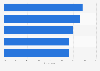
| Characteristic | Index score (on a scale of 1 to 7) |
|---|---|
| - | - |
| - | - |
| - | - |
The chart is not accessible to screen readers. Please switch to the table view to access the data.
September 2017
Belgium, Luxembourg, Netherlands
2016 and 2017
220 respondents
18 years and older
business executives**
Online survey
This question was phrased by the source as follows: "In your country, to what extent does the cost of financial services (e.g., insurance, loans, trade finance) impede business activity? [1 = impedes business to a great extent; 7 = not at all]"
** The numbers provided are the weighted average from a survey which took place in both 2015 and 2016. The exact number of respondents and weights per country were as follows:
Belgium: 65 respondents in 2015 and 51 respondents in 2016, with a weight of 48 and 52 percent respectively.
Luxembourg: 49 respondents in 2015 and 62 respondents in 2016, with a weight of 42.1 and 57.9 percent respectively.
Netherlands: 83 respondents in 2015 and 75 respondents in 2016, with a weight of 46.3 and 53.7 percent respectively.
The source states that the "the Global Competitiveness Index (GCI) combines 114 indicators that capture concepts that matter for productivity and long-term prosperity. These indicators are grouped into 12 pillars: institutions, infrastructure, macroeconomic environment, health and primary education, higher education and training, goods market efficiency, labor market efficiency, financial market development, technological readiness, market size, business sophistication, and innovation. These pillars are in turn organized into three subindexes: basic requirements, efficiency enhancers, and innovation and sophistication factors. The three subindexes are given different weights in the calculation of the overall Index, depending on each economy鈥檚 stage of development, as proxied by its GDP per capita and the share of exports represented by raw materials".