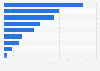
| Characteristic | Income in billion Canadian dollars |
|---|---|
| 2022 | 237.16 |
| 2021 | 253.93 |
| 2020 | 294.42 |
| 2019 | 197.22 |
| 2018 | 187.95 |
| 2017 | 180.61 |
| 2016 | 171.16 |
| 2015 | 162.31 |
| 2014 | 150.01 |
| 2013 | 145.05 |
| 2012 | 140.51 |
| 2011 | 135.14 |
| 2010 | 132.6 |
| 2009 | 126.29 |
| 2008 | 115.65 |
| 2007 | 110.12 |
| 2006 | 106.32 |
| 2005 | 99.06 |
| 2004 | 94.59 |
| 2003 | 91.34 |
| 2002 | 88.58 |
The chart is not accessible to screen readers. Please switch to the table view to access the data.
June 2024
Canada
2002 to 2022
1) Taxfilers are people who filed a tax return for the reference year and were alive at the end of the year.
2) Dependent is a member of a family who did not file a personal income tax return for the referenced year.
3) Government transfer payments are payments to individuals by the federal or provincial governments: Employment Insurance (EI), Goods and Services Tax Credit (GST) and Harmonized Tax Credit (HST), Canada Child Tax Benefit, Old Age Security (OAS) and net federal supplements, Canada Pension Plan (CPP) and Quebec Pension Plan (QPP), Workers' Compensation, Social Assistance and provincial refundable tax credits, Family Benefits and Other Government Transfers. Other Government Transfers (new in 2010) includes Working Income Tax Benefit. Adapted from Statistics Canada, statcan.gc.ca, 2001 to 2021. This does not constitute an endorsement by Statistics Canada of this product.