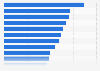
| Characteristic | Proportion of all staff with skills gaps |
|---|---|
| Technical, practical or job-specific | 65% |
| Problem solving | 41% |
| Customer handling | 39% |
| Team working | 37% |
| Numeracy | 30% |
| Written communication | 28% |
| Planning and organisation | 26% |
| Basic computer literacy / using IT | 23% |
| Advanced IT or software | 21% |
| Strategic Management | 21% |
| Literacy | 18% |
| Oral communication | 17% |
| Foreign language | 16% |
The chart is not accessible to screen readers. Please switch to the table view to access the data.
Loading statistic...
Download
Source
Source
Release date
October 2018
More information
Region
United Kingdom
Survey time period
March and July 2017
Method of interview
Telephone interview
Supplementary notes
* A 鈥渟kills gap鈥� is defined by the source as when an employee is not fully proficient, i.e. is not able to do their job to the required level.
Methodology and background note (from source):
To ascertain the number of staff with skills gaps, respondents were asked, for each major (one-digit SOC 2010) occupation where they employed staff, how many of those they employed were fully proficient. If respondents asked for clarification, then a proficient employee was described as 鈥榮omeone who is able to do their job to the required level鈥�.
Citation formats