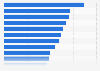
| Characteristic | Proportion of all skills gaps |
|---|---|
| New to role and/or training incomplete | 73% |
| Staff are new to the role | 60% |
| Their training is currently only partially completed | 56% |
| Staff lack motivation | 34% |
| They have been on training but their performance has not improved sufficiently | 29% |
| The introduction of new working practices | 28% |
| Unable to recruit staff with the required skills | 26% |
| Staff have not received the appropriate training | 26% |
| The introduction of new technology | 20% |
| The development of new products and services | 19% |
| Problems retaining staff | 18% |
The chart is not accessible to screen readers. Please switch to the table view to access the data.
Loading statistic...
Download
Source
Source
Release date
July 2016
More information
Region
United Kingdom
Survey time period
March and July 2015
Number of respondents
18,265 respondents
Special properties
All establishments with skills gaps; up to two skills gaps followed up
Method of interview
Telephone interview
Supplementary notes
* A 鈥渟kills gap鈥� is defined by the source as when an employee is not fully proficient, i.e. is not able to do their job to the required level. Please see page 181 of the source report for a more detailed description.
It should be noted that employers were able to give multiple responses to this question. As such, although 75 per cent of skills gaps were at least in part due to transient issues, this does not imply that just 25 percent relate to longer-term issues.
Citation formats