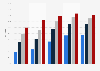
| Characteristic | Index score |
|---|---|
| Czechia | 70 |
| Estonia | 63.3 |
| Slovenia | 61.4 |
| Poland | 60.5 |
| Croatia | 60.2 |
| Latvia | 53.3 |
| Hungary | 53 |
| Slovakia | 52.6 |
| Lithuania | 51.8 |
| Romania | 39.9 |
| Bulgaria | 37.7 |
The chart is not accessible to screen readers. Please switch to the table view to access the data.
May 2023
Central and Eastern Europe
2022
The European Skills Index (ESI) is Cedefop鈥檚 composite indicator measuring the performance of EU skills systems. The ESI measures countries鈥� 鈥渄istance to the ideal鈥� performance. This ideal performance is chosen as the highest achieved by any country over a period of 7 years. The ideal performance is scaled to be 100 and the scores of all countries are then computed and compared to that. The ESI consists of three pillars; skills development, activation and matching, each of which measures a different aspect of a skills system. Basis of the ESI are 15 individual indicators from various international datasets. The scores are calculated across countries at the indicators鈥� level. The scores are then averaged at the various layers and finally the Index score is formed. To illustrate, an Index (or pillar, sub-pillar etc.) score of 65 suggests that the country has reached 65% of the ideal performance. Thus, there is still 35% (100-65) room for improvement. A score of 100 corresponds to achieving the 鈥榝rontier鈥�, that is an aspirational target performance for that indicator. A score of 0 corresponds to a lowest-case performance.