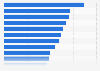
| Characteristic | Proportion of all vacancies |
|---|---|
| Specialist skills or knowledge | 65% |
| Solving complex problems | 41% |
| Knowledge of products and services offered | 38% |
| Knowledge of how the organisation works | 32% |
| Complexnumerical/statistical skills | 27% |
| Reading/understanding instructions,reports etc | 33% |
| Writing instructions, reports etc. | 28% |
| Basic numerical skills | 30% |
| Computer literacy / basic IT skills | 23% |
| Advanced or specialist IT skills | 21% |
| Adapting to new equipment or materials | 22% |
| Manual dexterity | 17% |
| Communicating in a foreign language | 16% |
The chart is not accessible to screen readers. Please switch to the table view to access the data.
October 2018
United Kingdom
March and July 2017
3,244 respondents
Telephone interview
* Skill-shortage vacancies (SSVs) are defined as "vacancies which are proving difficult to fill due to the establishment not being able to find applicants with the appropriate skills, qualifications or experience."
Methodology and background note (from source):
During the survey, employers were first asked to give their reasons for not being able to fill vacancies spontaneously (i.e. without being presented with a list of possible reasons). Any employers not reporting skills-related issues were then prompted as to whether any of their hard-to-fill vacancies were proving hard-to-fill due to a lack of skills, experience or qualifications among applicants.
Employers who reported having vacancies that were difficult to fill because of skill shortages were read a list of types of skills and asked, for each occupation in which they reported skill-shortage vacancies, which skills were lacking. This statistic shows results based on the total number of skill-shortage vacancies (as opposed to establishments with skill-shortage vacancies).