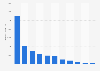
| Characteristic | Total emissions intensity in kg/CO鈧俥/Boe |
|---|---|
| Peace River (extra-heavy oil) | 867 |
| Primrose (extra-heavy oil) | 790 |
| Kearl (extra-heavy oil) | 740 |
| Foster Creek (extra-heavy oil) | 708 |
| Firebag (extra-heavy oil) | 706 |
| Cold Lake (extra-heavy oil) | 696 |
| Surmont (extra-heavy oil) | 689 |
| MacKay River (extra-heavy oil) | 687 |
| Jackfish (extra-heavy oil) | 672 |
| Horizon (extra-heavy oil) | 671 |
| Muskeg River (extra-heavy oil) | 666 |
| Jackpine (extra-heavy oil) | 666 |
| Duvernay (condensate) | 662 |
| Christina Lake (extra-heavy oil) | 651 |
| Cardium (wet gas) | 646 |
| Spirit River (wet gas) | 625 |
| Hibernia (light oil) | 622 |
| Fort Hills (extra-heavy oil) | 616 |
| Foothills (condensate) | 586 |
| Hebron (heavy oil) | 586 |
| Montney AB (wet gas) | 586 |
| Montney BC (wet gas) | 511 |
| Bakken-CA (light oil) | 497 |
The chart is not accessible to screen readers. Please switch to the table view to access the data.
Loading statistic...
Download
Source
Source
Release date
April 2024
More information
Region
Canada
Survey time period
2022
Supplementary notes
Figures are for total lifecycle emissions that come from upstream, midstream, and downstream oil and gas operations and end uses.聽This includes production, refining and petrochemical processing, gathering, storage, and transportation, and end uses. Calculations assume a 20-year global warming potential of non-CO鈧� emissions.
The source does not provide a release date and has therefore been set as the date of site access.
Citation formats