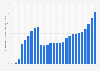
| Characteristic | Share of respondents |
|---|---|
| Without disabilities | 7.1% |
| With disabilities | 20% |
| Excellent, very good or good health | 6.3% |
| Fair or poor health | 18% |
The chart is not accessible to screen readers. Please switch to the table view to access the data.
June 2023
North America, United States
2021
18-64 years
Computer-assisted personal interviewing might have also occurred
Face-to-face interviews, telephone interviews
Disability status: Classified by the level of difficulty reported in the Washington Group Short Set on Functioning. The six domains of functioning include: vision (even with glasses), hearing (even with hearing aids), mobility (walking or climbing stairs), communication (understanding or being understood by others), cognition (remembering or concentrating), and self-care (such as bathing or dressing). Adults who responded 鈥渁 lot of difficulty鈥� or 鈥渃annot do at all鈥� to at least one of the six questions are deemed to have disabilities.
Adults who did not take medication as prescribed were categorized as those who reported taking prescription medications in the last 12 months to the study and responded 鈥測es鈥� to at least one of the following:聽
鈥淒uring the last 12 months, were any of the following true for you:
1) Skipped medication doses to save money;
2) Took less medication to save money;
3) Delayed filling a prescription to save money.鈥�
Estimates are based on household interviews of a sample of the U.S. civilian noninstitutionalized population.
NHIS is a cross-sectional household interview survey. The target population for the NHIS is the civilian noninstitutionalized population residing within the 50 states and the District of Columbia at the time of the interview.