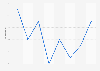
| Characteristic | Explosions / remote violence | Battles | Strategic developments | Violence against civilians | Protests |
|---|---|---|---|---|---|
| Q2 2023 | 9,820 | 1,899 | 235 | 24 | 4 |
| Q1 2023 | 8,931 | 2,239 | 176 | 19 | 3 |
| Q4 2022 | 8,664 | 1,902 | 418 | 72 | 4 |
| Q3 2022 | 11,034 | 1,497 | 281 | 159 | 24 |
| Q2 2022 | 5,747 | 1,313 | 414 | 226 | 27 |
| Q1 2022 | 1,493 | 762 | 240 | 383 | 108 |
The chart is not accessible to screen readers. Please switch to the table view to access the data.
August 2023
Ukraine
Q1 2022 to Q2 2023
The source specified the following information: "ACLED collects and codes reported information on political violence, demonstrations (rioting and protesting) and select non-violent, politically important events. It aims to capture the modes, frequency and intensity of political violence and opposition as it occurs.
Political violence is defined as the use of force by a group with a political purpose or motivation. ACLED records political violence through its constituent events, the intent of which is to produce a comprehensive overview of all forms of political disorder, expressed through violence and demonstrations, within and across states. A politically violent event is a single altercation where often force is used by one or more groups toward a political end, although some non-violent instances 鈥� including protests and strategic developments 鈥� are included in the dataset to capture the potential pre-cursors or critical junctures of a violent conflict."
The codebook with definitions can be accessed on the source's .
Release date is the date of access.