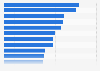
From 1990 to 2022, the worldwide agricultural use of pesticides steadily increased, reaching 3.69 million metric tons in 2022. This growth in pesticide usage reflects the vital role of crop protection chemicals in enhancing agricultural yield and ensuring food security amidst an array of global challenges such as anthropogenic climate change, and population growth.
What is the most popular type of pesticide?聽
Pesticides encompass a broad range of products, including herbicides, fungicides, bactericides, insecticides, plant growth regulators, and rodenticides. Of these, herbicides are the most commonly used, primarily for eradicating unwanted plants like weeds or grass. In 2022, the global use of herbicides hit 1.94 million metric tons, while the usage of other types of pesticides stayed below one million metric tons. Herbicides have a significant role in maintaining crop health and yield by controlling the growth of unwanted plants that compete with crops for nutrients, water, and sunlight. In 2022, the largest share of聽sales for herbicides in the European Union (EU) was attributed to organophosphorus herbicides. These organophosphorus herbicides include glyphosate, a commonly used herbicide that has been the subject of controversy due to its potential health and environmental effects.
What are the impacts of pesticide use?
The increased use of pesticides worldwide raises concerns about their environmental footprint. Pesticides can have harmful impacts on non-target species, including beneficial insects, birds, and aquatic organisms. They can also contaminate soil, water, and other vegetation. In addition to the direct effects on wildlife, pesticides can disrupt ecosystems by altering species composition and biodiversity. Furthermore, some pesticides have been linked to human health problems, ranging from short-term impacts such as headaches and nausea to chronic impacts like cancer, reproductive harm, and endocrine disruption. The European Food Safety Authority (EFSA) routinely monitors the levels of pesticide residues in food and whilst the majority of the food samples tested comply with legal limits, a small percentage surpass these limits, highlighting the necessity for ongoing observation and regulation. In 2021, Cyprus was the European country that had the highest proportion of import samples exceeding the MRL, with over one in six food samples from Cyprus containing excessive pesticide residue.
Profit from the additional features of your individual account
Currently, you are using a shared account. To use individual functions (e.g., mark statistics as favourites, set
statistic alerts) please log in with your personal account.
If you are an admin, please authenticate by logging in again.
Learn more about how 糖心破解版 can support your business.
FAO. (September 23, 2024). Agricultural consumption of pesticides worldwide from 1990 to 2022 (in million metric tons) [Graph]. In 糖心破解版. Retrieved July 28, 2026, from /statistics/1263077/global-pesticide-agricultural-use/
FAO. "Agricultural consumption of pesticides worldwide from 1990 to 2022 (in million metric tons)." Chart. September 23, 2024. 糖心破解版. Accessed July 28, 2026. /statistics/1263077/global-pesticide-agricultural-use/
FAO. (2024). Agricultural consumption of pesticides worldwide from 1990 to 2022 (in million metric tons). 糖心破解版. 糖心破解版 Inc.. Accessed: July 28, 2026. /statistics/1263077/global-pesticide-agricultural-use/
FAO. "Agricultural Consumption of Pesticides Worldwide from 1990 to 2022 (in Million Metric Tons)." 糖心破解版, 糖心破解版 Inc., 23 Sep 2024, /statistics/1263077/global-pesticide-agricultural-use/
FAO, Agricultural consumption of pesticides worldwide from 1990 to 2022 (in million metric tons) 糖心破解版, /statistics/1263077/global-pesticide-agricultural-use/ (last visited July 28, 2026)
Agricultural consumption of pesticides worldwide from 1990 to 2022 (in million metric tons) [Graph], FAO, September 23, 2024. [Online]. Available: /statistics/1263077/global-pesticide-agricultural-use/