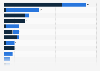
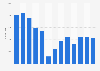
| Characteristic | Analytical | Non-analytical |
|---|---|---|
| 2020 | 64 | 71 |
| 2019 | 99 | 68 |
| 2018 | 119 | 25 |
| 2017 | 55 | 27 |
| 2016 | 45 | 24 |
| 2015 | 162 | 14 |
| 2014 | 133 | 15 |
| 2013 | 212 | 13 |
The chart is not accessible to screen readers. Please switch to the table view to access the data.
May 2023
Russia
2013 to 2020
Recorded through urine and blood tests.
The statistic has been compiled from several reports by the source.
The source specified the following information (page 5):
"An analytical ADRV refers to a violation of Code Article 2.1 (Presence of a prohibited substance or its metabolites or markers in an athlete鈥檚 sample) and is based on an AAF (otherwise known as a positive result), which indicates the presence of a prohibited substance or its metabolite(s) or of marker(s) of the use of a prohibited substance in a urine and/or blood sample collected from an
athlete and analyzed by a WADA-accredited Laboratory.
A non-analytical ADRV is a case in which an athlete or athlete support person (coach, trainer, manager, agent, medical staff, parent, etc.) commits another type of ADRV that does not involve the detection of a prohibited substance or prohibited method in a urine or blood sample from athletes, as outlined in the 2015 World Anti-Doping Code (Code) Articles 2.2 to 2.10."