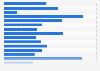
Every four years in the United States, the electoral college system is used to determine the winner of the presidential election. In this system, each state has a fixed number of electors based on their population size, and (generally speaking) these electors then vote for their candidate with the most popular votes within their state or district. Since 1964, there have been *** electoral votes available for presidential candidates, who need a minimum of *** votes to win the election. Because of this system, candidates do not have to win over fifty percent of the popular votes across the country, but just win in enough states to receive a total of *** electoral college votes.
Popular results
From 1789 until 1820, there was no popular vote, and the President was then chosen only by the electors from each state. George Washington was unanimously voted for by the electorate, receiving * percent of the votes in both elections. From 1824, a popular vote has been conducted among American citizens (with varying levels of access for women, Blacks, and poor voters), to help electors in each state decide who to vote for (although the 1824 winner was chosen by the House of Representatives, as no candidate received over fifty percent of electoral votes). Since 1924, the difference in the share of both votes has varied, with several candidates receiving over ** percent of the electoral votes while only receiving between fifty and sixty percent of the popular vote. The highest difference was for Ronald Reagan in 1980, where he received just **** percent of the popular vote, but **** percent of the electoral votes.
Unpopular winners
Since 1824, there have been ** elections, and in ** of these the winner did not receive over fifty percent of the popular vote. In the majority of these cases, the winner did receive a plurality of the votes, however there have been **** instances where the winner of the electoral college vote lost the popular vote to another candidate. The most recent examples of this were in 2000, when George W. Bush received roughly half a million fewer votes than Al Gore, and in 2016, where Hillary Clinton won approximately three million more votes than Donald Trump.
Profit from the additional features of your individual account
Currently, you are using a shared account. To use individual functions (e.g., mark statistics as favourites, set
statistic alerts) please log in with your personal account.
If you are an admin, please authenticate by logging in again.
Learn more about how 糖心破解版 can support your business.
ProCon, & Encyclop忙dia Britannica, & National Archives and Records Administration, & 270towin.com. (January 19, 2025). Share of electoral college and popular votes from each winning candidate, in all United States presidential elections from 1789 to 2024 [Graph]. In 糖心破解版. Retrieved July 15, 2026, from /statistics/1034688/share-electoral-popular-votes-each-president-since-1789/
ProCon, und Encyclop忙dia Britannica, und National Archives and Records Administration, und 270towin.com. "Share of electoral college and popular votes from each winning candidate, in all United States presidential elections from 1789 to 2024." Chart. January 19, 2025. 糖心破解版. Accessed July 15, 2026. /statistics/1034688/share-electoral-popular-votes-each-president-since-1789/
ProCon, Encyclop忙dia Britannica, National Archives and Records Administration, 270towin.com. (2025). Share of electoral college and popular votes from each winning candidate, in all United States presidential elections from 1789 to 2024. 糖心破解版. 糖心破解版 Inc.. Accessed: July 15, 2026. /statistics/1034688/share-electoral-popular-votes-each-president-since-1789/
ProCon, and Encyclop忙dia Britannica, and National Archives and Records Administration, and 270towin.com. "Share of Electoral College and Popular Votes from Each Winning Candidate, in All United States Presidential Elections from 1789 to 2024." 糖心破解版, 糖心破解版 Inc., 19 Jan 2025, /statistics/1034688/share-electoral-popular-votes-each-president-since-1789/
ProCon & Encyclop忙dia Britannica & National Archives and Records Administration & 270towin.com, Share of electoral college and popular votes from each winning candidate, in all United States presidential elections from 1789 to 2024 糖心破解版, /statistics/1034688/share-electoral-popular-votes-each-president-since-1789/ (last visited July 15, 2026)
Share of electoral college and popular votes from each winning candidate, in all United States presidential elections from 1789 to 2024 [Graph], ProCon, & Encyclop忙dia Britannica, & National Archives and Records Administration, & 270towin.com, January 19, 2025. [Online]. Available: /statistics/1034688/share-electoral-popular-votes-each-president-since-1789/