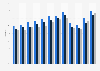
| Characteristic | Number of users in millions | Penetration rate (%) |
|---|---|---|
| - | - | - |
| - | - | - |
| - | - | - |
| - | - | - |
| - | - | - |
| - | - | - |
| - | - | - |
| - | - | - |
| - | - | - |
| - | - | - |
| - | - | - |
| - | - | - |
The chart is not accessible to screen readers. Please switch to the table view to access the data.
* forecast
Neobrokers are financial entities that operate solely in the digital space. They typically position themselves as online brokers, trading platforms, social trading platforms, or retail investment platforms. The evolution of neobrokers began around 2005, when the first firms providing such services were founded. These companies do not belong to other more conventional financial enterprises; however, they might partner with banks to enable more efficient and secure deposits and transfers.
Neobrokers require digital onboarding of its clients and do not have physical branches to provide consultations and services to their customers. Nevertheless, it is not mandatory for their potential clients to have a smartphone to open an account. Neobrokers can charge fees for theirs services, but some provide it for free. Given the nature of online trading activities, neobroker services can be accessed either via a mobile app or via a desktop website.
Within our market scope, we focus only on those neobrokers that provide either exclusively B2C or both B2B and B2C services; those that solely work with B2B clients are excluded from the market. Companies that only provide robo-advisory services and/or only facilitate the trading of cryptocurrencies are also excluded from the scope of this market. Cryptocurrencies were excluded from the scope of this market as well.