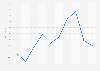
| Characteristic | Number of children in families receiving benefits |
|---|---|
| - | - |
| - | - |
| - | - |
| - | - |
| - | - |
| - | - |
| - | - |
| - | - |
| - | - |
| - | - |
| - | - |
| - | - |
| - | - |
| - | - |
| - | - |
| - | - |
| - | - |
| - | - |
| - | - |
| - | - |
| - | - |
The chart is not accessible to screen readers. Please switch to the table view to access the data.
Download
Source
Source
Release date
July 2025
More information
Region
Germany
Survey time period
2005 to 2025*
Age group
Under 18 years
Special properties
With and without their own entitlement to benefits
Supplementary notes
* The German term is "Bedarfsgemeinschaften" which is a legal term from German social law, particularly under the Second Book of the Social Code (SGB II), which pertains to basic income support for job seekers. It refers to a household community where the members are economically dependent on one another and are considered together when determining eligibility and the number of social benefits.
Examples of this are:
- Spouses who are not permanently separated
- Registered same-sex life partners who are not permanently separated
- People in a community of responsibility and commitment (鈥渕arriage-like community鈥�).
- The benefit community also includes children who live in the household and are younger than 25 years old. Requirement: They are unmarried, able to work and cannot support yourself from your own income. Children's income includes, for example, child benefit or maintenance payments.聽
Citation formats