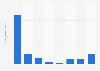
| Birth defect category | Total cost in U.S. dollars |
|---|---|
| Cardiovascular | 9,833,000,308 |
| Musculoskeletal | 4,139,059,463 |
| Genitourinary | 3,827,722,973 |
| Central nervous system | 3,170,662,573 |
| Cardiovascular, critical | 2,810,676,170 |
| Chromosomal | 2,629,174,588 |
| Gastrointestinal | 2,372,323,342 |
| Integumentary | 1,968,999,140 |
| Cleft lip or palate or both | 371,907,278 |
| Eye | 353,579,767 |
| Ear | 311,185,562 |
| Other syndrome affecting multiple systems | 1,040,175,603 |
| Other defect | 2,757,425,472 |
The chart is not accessible to screen readers. Please switch to the table view to access the data.
July 2023
United States
2019
Younger than 65 years
The source notes that hospitalizations with at least one birth defect鈥揳ssociated discharge diagnosis were identified "by scanning up to 40 available fields for ICD-10-CM diagnosis codes Q00鈥換99: congenital malformations, deformations, and chromosomal abnormalities. Patent ductus arteriosus (Q25.0) and atrial septal defect (Q21.1) were not considered birth defects when occurring in neonates aged <28 days or with an associated indicator of preterm birth (ICD-10-CM codes P07.2 or P07.3). An additional 23 conditions of lesser clinical importance classified within the Q00鈥換99 code range were not considered birth defects."
Concerning birth defect categories the source notes: " Birth defects categories correspond to blocks of ICD-10-CM diagnosis codes: cardiovascular (Q20鈥換28), central nervous system (Q00鈥換07), chromosomal (Q90鈥換99), cleft lip/palate (Q35鈥換37), ear (Q16鈥換17), eye (Q10鈥換15), gastrointestinal (Q38鈥換45), genitourinary (Q50鈥換64), integumentary (Q80鈥換85), musculoskeletal (Q65鈥� Q79), and other syndrome (Q87). 鈥淥ther defect鈥� includes birth defects of the face and neck (Q18), respiratory system (Q30鈥換34), and other congenital malformations (Q86 and Q89)."