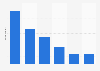
| Characteristic | I am worried about its growing regional economic influence | I welcome its growing regional economic influence |
|---|---|---|
| - | - | - |
| - | - | - |
The chart is not accessible to screen readers. Please switch to the table view to access the data.
April 2024
Asia, APAC
January 3 to February 23, 2024
405 respondents
among Southeast Asian respondents
CAPI interview, questionnaire
Original question: "What is your view of this political and strategic power鈥檚 influence on your country?"
Respondents included those who previously answered "ASEAN" in response to a question about which country or regional organization is currently the most influential political power in Southeast Asia.
ASEAN stands for Association of Southeast Asian Nations and is a political and economic union composed of the ten member states Brunei, Cambodia, Indonesia, Laos, Malaysia, Myanmar, Philippines, Singapore, Thailand, and Vietnam.
On their calculation methodology for ASEAN average figures, the source states the following:
We decided to apply a different methodology this year assigning a 10% weighted average to each country鈥檚 responses to calculate the average figures for ASEAN as a whole. This is to ensure that the responses of each country are represented by equal proportion, given that ASEAN鈥檚 decision-making processes are based on each country having equal say, regardless of country or population size.
Number of respondents in 2024 overall survey: n = 1,994
Respondent share by nationality:
Brunei: n = 3.2% (2021) 3.2% (2022) 9.2% (2023) 3.9% (2024)
Cambodia: n = 2.5% (2021) 4.8% (2022) 10.2% (2023) 9.5% (2024)
Indonesia: n = 12.5% (2021) 7.8% (2022) 9.3% (2023) 13.3% (2024)
Laos: n = 3.9% (2021) 2.6% (2022) 8.2% (2023) 8% (2024)
Malaysia: n = 11.3% (2021) 8.1% (2022) 9.5% (2023) 11.3% (2024)
Myanmar: n = 15.1% (2021) 20.9% (2022) 8.8% (2023) 9.5% (2024)
Philippines: n = 6.5% (2021) 23.9% (2022) 7.6% (2023) 10.8% (2024)
Singapore: n = 15.3% (2021) 13.2% (2022) 15.9% (2023) 13.7% (2024)
Thailand: n = 12.7% (2021) 7% (2022) 11% (2023) 10.1% (2024)
Vietnam: n = 17% (2021) 8.6% (2022) 10.4% (2023) 10% (2024)