| Characteristic | Index score (0-100) |
|---|---|
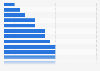
| Norway | 97 |
| San Marino | 97 |
| Marshall Islands | 96 |
| Palau | 96 |
| Barbados | 95 |
| Liechtenstein | 95 |
| Denmark | 94 |
| Luxembourg | 94 |
| Finland | 92 |
| Estonia | 91 |
| Grenada | 91 |
| Kiribati | 91 |
| Monaco | 91 |
| St Vincent and the Grenadines | 91 |
| Tuvalu | 91 |
| Micronesia | 90 |
| Iceland | 89 |
| New Zealand | 89 |
| Saint Lucia | 88 |
| Uruguay | 88 |
The chart is not accessible to screen readers. Please switch to the table view to access the data.
Loading statistic...
Download
Source
Source
Release date
March 2025
More information
Region
Worldwide
Survey time period
2024
Supplementary notes
The source defines civic space as "the respect in policy, law, and practice for freedoms of association, peaceful assembly, and expression and the extent to which the state protects these fundamental rights."
The ranking is based on assessments made by 20 organizations with expertise on the topic. It includes 198 countries and territories that are given a ranking from zero (closed civic space) to 100 (open civic space), which are classified as either open, narrowed, obstructed, repressed, or closed. For more about the methodology behind the ranking, please visit the source's聽.
Citation formats