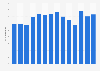
| Characteristic | ILO estimate | National estimate |
|---|---|---|
| - | - | - |
| - | - | - |
| - | - | - |
| - | - | - |
| - | - | - |
| - | - | - |
| - | - | - |
| - | - | - |
| - | - | - |
| - | - | - |
| - | - | - |
| - | - | - |
| - | - | - |
| - | - | - |
| - | - | - |
| - | - | - |
| - | - | - |
| - | - | - |
| - | - | - |
| - | - | - |
| - | - | - |
The chart is not accessible to screen readers. Please switch to the table view to access the data.
May 2022
Egypt
2000 to 2020
Figures have been rounded.
Data are estimates.
According to the source, ILO estimates on "unemployment refers to the share of the labor force that is without work but available for and seeking employment." and that "definitions of labor force and unemployement differ by country"
The source adds the following information: "The ILO modelled estimates series provides a complete set of internationally comparable labour statistics, including both nationally reported observations and imputed data for countries with missing data. The imputations are produced through a series of econometric models maintained by the ILO."
For more information on the methodology of ILO estimate please press .