| Characteristic | Children of kindergarten age | Children of elementary school age | Children of secondary school age |
|---|---|---|---|
| - | - | - | - |
| - | - | - | - |
| - | - | - | - |
| - | - | - | - |
| - | - | - | - |
| - | - | - | - |
The chart is not accessible to screen readers. Please switch to the table view to access the data.
May 2020
Germany
April 22 to May 4, 2020
1,754 to 3,282 respondents**
Parents of children aged 3 to 15 years
Computer-assisted web interviews (CAWI)
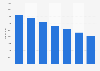
The surveyed parents had the following options to answer the question 鈥濰ow did the time your child spends with the following people change overall?": "More time together", "Same time together" or "Less time together". This statistic only refers to the first option. Missing percentages to 100 percent: "Same time together"/ "Less time together".
** Number of respondents varied depending on the children's age group:
Children of kindergarten age: 2,348 鈥� 3,282 respondents
Children of elementary school age: 2,056 鈥� 2,660 respondents
Children of secondary school age: 1,754 鈥� 2,049 respondents
The first results of the study Being a Child in the Time of Corona (German: Kindsein in Zeiten von Corona by the German Youth Institute (Deutsches Jugendinstitut, DJI), on which this statistic is based, are connected to the fieldwork phase during the survey period from April 22 to May 4, 2020. During this time, a total of 8,127 respondents from all 16 German federal states were surveyed. According to the DJI, the survey period for the study continued until May 20, 2020. According to the source, the study was conducted via computer-assisted web interviews (CAWI), based on a convenience sample with a snowball effect approach. The study was advertised via social networks, email lists, contacts and networks of social associations, youth welfare offices and institutions responsible for day care centers. Representative random sampling was not conducted due to time-related reasons. Therefore, generalized statements about the German population or certain subgroups in the population cannot be made. Nevertheless, it should be possible to indicate general tendencies based on the study results.
Further information on the approach and methodology available via source link (page 1).