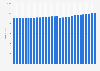
| Characteristic | Number of inhabitants |
|---|---|
| 2023 | 1,910,160 |
| 2022 | 1,892,122 |
| 2021 | 1,853,935 |
| 2020 | 1,852,478 |
| 2019 | 1,847,253 |
| 2018 | 1,841,179 |
| 2017 | 1,830,584 |
| 2016 | 1,810,438 |
| 2015 | 1,787,408 |
| 2014 | 1,762,791 |
| 2013 | 1,746,342 |
| 2012 | 1,734,272 |
| 2011 | 1,718,187 |
| 2010 | 1,786,448 |
| 2005 | 1,743,627 |
| 2000 | 1,715,392 |
| 1995 | 1,707,901 |
| 1990 | 1,652,363 |
| 1980 | 1,645,095 |
| 1970 | 1,793,640 |
| 1960 | 1,836,958 |
The chart is not accessible to screen readers. Please switch to the table view to access the data.
June 2024
Germany
1960 to 2023
Update results are represented. The last census in each case forms the basis for updating the population figures (the last census took place in 2011). According to the source, the update of population figures overall, and by age and gender, is based on statistical results on natural population movements (births, deaths) and on spatial population movements (migration across municipal boundaries), which were compiled on the basis of administrative data. The basic data for statistics on births and deaths are provided by the registry offices. The regional classification is based on the place of residence of the mother for those born and the place of residence of the deceased. The basic data for migration statistics are supplied by the registration offices.
The cut-off date is always December 31.
From 2011: results based on the 2011 census.
This statistic can be accessed at the Genesis-Online database of the Federal Statistical Office under the link given in the reference of origin. Enter the code "12411-0010" in the search bar.