It鈥檚 been 100 years since the first public demonstration of television. Back on January 26, 1925, Scottish inventor John Logie Baird opened up his workshop to give Londoners a show of his mechanical TV, starring Stooky Bill, his ventriloquist dummy. Over the following decades, television was to evolve rapidly, with the British Broadcasting Corporation (BBC) airing the world鈥檚 first ever regular TV service from 1936. In the United States, just some of the landmark moments to hit screens across the country included the 1960 Kennedy-Nixon debate, the funeral of John F. Kennedy in 1963, the 1969 Apollo 11 moon landing, O.J. Simpson鈥檚 car chase in 1994 and the 9/11 attacks coverage - to name but a few.
In the United States, the first public demonstration of television took place at the World鈥檚 Fair in New York City in 1939. Shortly after World War II, the industry started to grow and began to enter the American mainstream by the early 50s. The period that ran roughly between 1948 and 1959 is widely considered the first 鈥淕olden Age鈥� of television. During this time, TV had become established as the country鈥檚 leading mass medium, with TV sets having become more affordable, with 90 percent of homes owning a TV by 1959. According to , the era refers 鈥渁s much to America鈥檚 warm embrace of the new invention as to the critically acclaimed live programs that aired during this period.鈥�
This period eventually gave way due to a number of factors, including the expansion of programming and genres, which led to a perceived decline in quality. One of the other reasons for the shift was a series of allegations that many of the then-popular quiz shows had been rigged, with contestants told answers before going on air for dramatic effect.
Even with this change in views, TV viewing continued to increase in the U.S. to more than five hours a day by the start of the 60s, while radio usage had declined to less than two hours. According to , viewership rose still further in the following years, reaching a peak of the average American household watching approximately 8 hours and 55 minutes per day in 2009-2010.
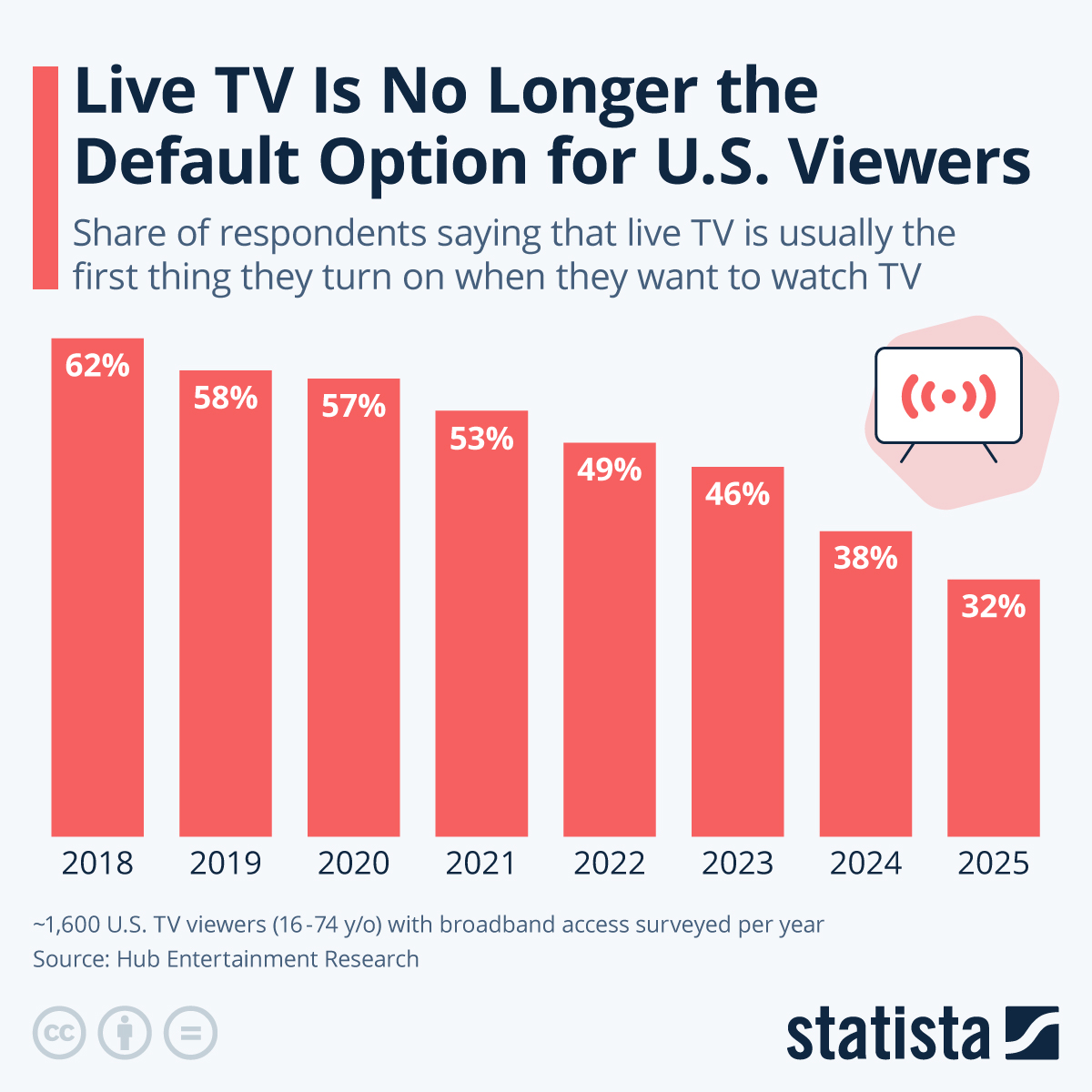
In the years since, TV viewership has generally been on the decline in the United States, largely driven by a mass migration of audience toward streaming platforms. In a by Hub Entertainment Research, where 62 percent of U.S. respondents said that live TV was usually the first thing they turn on when they want to watch TV in 2018, by 2025, this figure had nearly halved to 32 percent.