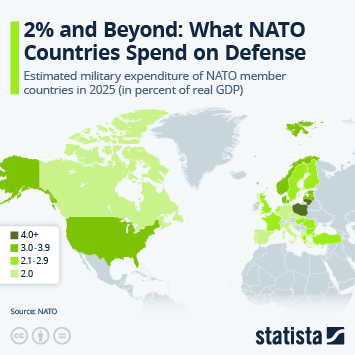
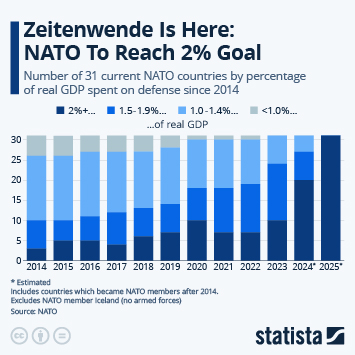
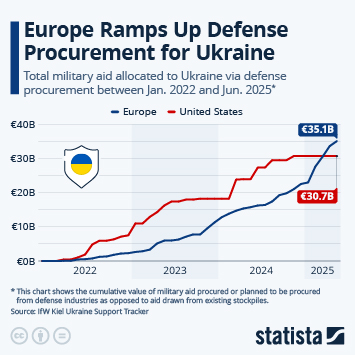
As Europe is determined to bolster its defense and assume an even larger role in supplying Ukraine with military equipment, the European Union 鈥� infamously leaning towards austerity and debt avoidance 鈥� is prepared to loosen the fiscal chains on its member countries. As part of its suggested ReArm Europe plan, the European Commission plans to free member states from the debt and deficit rules of the Stability and Growth Pact, hoping to create 鈧�650 billion in additional fiscal space over a period of four years.
While that sounds like a huge additional burden on Europe鈥檚 struggling economy, experts are pointing out that the planned increase in defense spending could even boost Europe鈥檚 economic growth. That is if the additional spending is largely debt-financed and used to foster domestic research, development and production rather than just purchasing armaments from abroad.
鈥淭he growth effects of increased defense spending are crucial to the political debate in Europe 鈥� done right, the costs of military build-ups can be contained,鈥� Ethan Ilzetzki, author of 鈥濃�� and Professor at the London School of Economics, says. 鈥淭his means Europe can decide on defense budgets in the light of regional security priorities, without being distracted by any fears of economic disaster.鈥�
An increase of defense spending from just under 2 percent to 3.5 percent of GDP would cost around 鈧�300 billion annually, Moritz Schularick, President of the Kiel Institute for the World Economy says. If spent correctly, this sum could generate a similar amount of additional economic activity, he argues. The suggested increase in spending could result in 0.9 to 1.5 percent GDP growth, Ilsetzki鈥檚 analysis finds, which would be highly welcome, considering that just 0.9 percent in 2024.