The leaders of some of the world鈥檚 wealthiest countries traveled to Kananaskis in Alberta, Canada this week, where the 51st G7 Summit takes place from June 16 to 17. Set against the beautiful backdrop of the Canadian Rockies, the present leaders of the G7 as well as some of their key allies have plenty of topics to discuss, with tariffs, the global economy, escalating tensions in the Middle East and the war in Ukraine on top of the agenda.
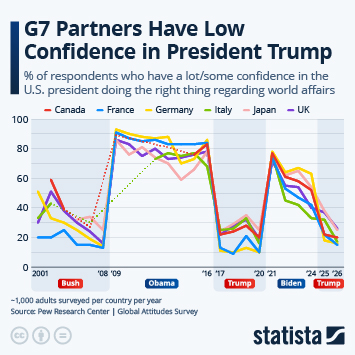
U.S. President Donald Trump was also present on Monday, meeting with the summit's host, Canadian Prime Minister Mark Carney and British Prime Minister Keir Starmer before discussing the conflict between Iran and Israel with all present G7 leaders. After agreeing on a calling for peace and stability in the Middle East and condemning Iran as "the principal source of regional instability and terror", Trump abruptly left the summit Monday night - an early departure that many saw as another sign of his disinterest in multilateralism and an affront to some of the closest U.S. allies.
While the Group of Seven, as the G7 is officially called, still claims a global leadership role, experts are questioning the bloc鈥檚 relevance against the backdrop of a rapidly evolving global economy. In 2018, Jim O鈥橬eill and Alessio Terzi, both former fellows of economic policy think tank Bruegel that the G7, 鈥渋n its current formulation, no longer has a reason to exist, and it should be replaced with a more representative group of countries.鈥� They called for a revised G7 group, which would replace Germany, France and Italy with a common Eurozone representative, swap Canada for Brazil and most importantly add China and India, making it more representative economically and in population terms without adding more seats to the table.
As the following chart shows, the G7 countries currently represent 28 percent of global GDP at purchasing power parity, down from more than 50 percent in the 1980s and early 1990s. In terms of population, the bloc is even less representative of the world it strives to lead, with its member countries accounting for less than 10 percent of the world鈥檚 population, according to from the UN Population Division. Despite these numbers, proponents of the G7 think the group still has value. 鈥淚t鈥檚 sort of a manageable steering group of the West,鈥� Stewart M. Patrick, Senior Fellow in at the (CFR) said. 鈥淭hey鈥檙e a repository, an embodiment of common values and a similar rules-based approach to world order.鈥�