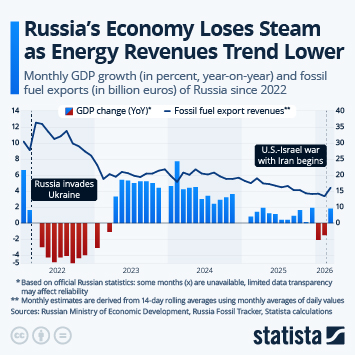
According to the IMF, Russian sovereign debt default is no longer 鈥渋mprobable鈥� as the country鈥檚 economy is reeling from sanctions and other international scrutiny following the invasion of Ukraine by Russian forces in late February. had downgraded the country to a C rating on March 8. The grade also signals that a default is expected imminently.
However, the IMF does not think that a Russian default would have a major ripple effect in the global economy as international banks鈥� exposure to Russian debt was
This debt is further broken down in Exposure to Russian debt was highest in Italy and France, where upwards of $25 billion was owed each at the end of the third quarter of 2021. In Austria and the U.S., exposure stood at $17.5 billion and $14.7 billion, respectively. One reason Austria ranks high is because one of the country鈥檚 largest banks, Raiffeisen, has a very active Russian subsidiary, which is one of the most lucrative parts of the company. The country also has deep business ties with Russia on energy. Austria, along with Germany, Italy, the Netherlands and Hungary, was reportedly among those who opposed banning Russia from international payment service Swift, which has also made it harder for Russian entities to settle their international debt.
As another consequence of the Swift ban, participating EU and G7 countries will also not be able to send money to banned Russian banks to pay for goods or services. While there has been a lot of talk about whether this means that Europe won鈥檛 be able to pay for natural gas it received from Russia, Gazprombank 鈥� which handles a lot of these payments as the financial arm of Russia鈥檚 state-own energy company 鈥� has not yet been restricted on the network.