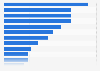
| Characteristic | Range of missiles in kilometers |
|---|---|
| Burkan-2 | 1,400 |
| Burkan-1 | 800 |
| Hwasong-6 | 500 |
| Scud B | 300 |
| Qahir-1 | 300 |
| Zelzal-3 | 250 |
| C-802* | 120 |
| Toshka | 70 |
The chart is not accessible to screen readers. Please switch to the table view to access the data.
December 2017
Saudi Arabia, Yemen, MENA
2018
*Anti-ship missile.
Yemen conflict summary:
Phase 1 - 2011. After the Arab Spring uprising in 2011, the longstanding and Saudi backed Yemeni President Ali Abdullah Saleh stood down in favor of his deputy Abdrabbuh Mansour Hadi. The country was unable to perform a stable political transition caused by not addressing issues of corruption, unemployment and poverty in due time. The political weakness of the new president Hadi was used by al-Qaeda and separatist movement to perform security attacks on the country.
Phase 2 - 2014. The power vacuum was used by the Houthi movement which is promoted by Zaidi Shia as well as disillusioned Sunni Muslims in Yemen to rebel openly and stronger against the government and to take over the capital Sanaa.
Phase 3 - 2015. Saudi Arabia-led intervention in the conflict was caused by two main factors. Firstly, Saudi Arabia shares a porous boarder with Yemen, the escalation was slowly compromising Saudi Arabia's own security. Furthermore, Saudi Arabia suspected that the Houthi Movement is backed by Iran, with whom they have shared a separate political conflict.