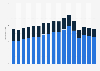
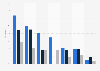
| Characteristic | Number of Arabs |
|---|---|
| - | - |
| - | - |
| - | - |
| - | - |
| - | - |
| - | - |
| - | - |
| - | - |
| - | - |
| - | - |
| - | - |
| - | - |
| - | - |
| - | - |
| - | - |
| - | - |
| - | - |
| - | - |
The chart is not accessible to screen readers. Please switch to the table view to access the data.
September 2025
United States
2006 to 2024
*No data available for 2020.
Arab Americans in this statistic refer to people of Arab ancestry.聽
The American Community Survey includes a question asking each individual about their "ancestry or ethnic origin." From the responses gathered, the U.S. Census Bureau defines anyone of Algerian, Bahraini, Egyptian, Emirati, Iraqi, Jordanian, Kuwaiti, Lebanese, Libyan, Moroccan, Omani, Palestinian, Qatari, Saudi Arabian, Syrian, Tunisian, or Yemeni descent to be of Arab ancestry.聽
The Census Bureau defines ancestry as the ethnic origin, descent, roots, heritage, or place of birth of the person or of the person's ancestors.