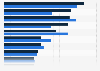

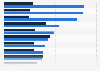


| Characteristic | Critical | Important | Somewhat important | Not important |
|---|---|---|---|---|
| - | - | - | - | - |
| - | - | - | - | - |
| - | - | - | - | - |
| - | - | - | - | - |
| - | - | - | - | - |
| - | - | - | - | - |
| - | - | - | - | - |
| - | - | - | - | - |
| - | - | - | - | - |
| - | - | - | - | - |
The chart is not accessible to screen readers. Please switch to the table view to access the data.
Download
Source
Sources
Release date
May 2022
More information
Region
Worldwide
Survey time period
February 2022
Number of respondents
1,000 respondents
Special properties
IT professionals knowledgeable about their organization鈥檚 security priorities, technologies, and strategies.
Supplementary notes
* Nascent 鈥� Organizations in the Nascent cohort use segmentation solutions that deliver very good capabilities across 0-2 areas (or the organization does not have a solution in place). A strong majority of organizations (69%) were grouped as Nascent. These organizations may still have work to accomplish with regard to Zero Trust Segmentation, but understanding the benefits the approach provides and best practices Pioneers employ can help them to prioritize areas of focus to refine their Zero Trust Segmentation approach over time.
鈥� Progressing 鈥� Those grouped as Progressing use segmentation solutions that deliver very good capabilities across 3-4 areas. Roughly one-quarter (24%) of our respondents were Progressing toward Zero Trust Segmentation. These organizations are typically already seeing the benefits based on their work and have a solid foundation from which to continue to build.
鈥� Pioneers 鈥� Pioneers are the most mature with regard to Zero Trust Segmentation and use segmentation solutions
that deliver very good capabilities across all 5 areas. Unsurprisingly, few organizations have reached the third stage of Zero Trust Segmentation maturity, with only 6% able to be accurately described as Pioneers. Those identified as Pioneers can use this report within their organization to validate the advantages they can expect to see based on the benefits others in their group have seen.
Citation formats