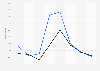
Price index base set in 2023 at 100; composite of 15 metropolitan areas
Supplementary notes
The data is a composite of eleven metropolitan areas, including: St. John's, Halifax, Moncton, Montr茅al, Ottawa-Gatineau, Toronto, Winnipeg, Saskatoon, Calgary, Edmonton, Vancouver.
Adapted from Statistics Canada, statcan.gc.ca, 1st quarter 2017 to 2nd quarter 2023. This does not constitute an endorsement by Statistics Canada of this product.
Citation formats
Price index for residential and non-residential construction in Canada 2017-2025
Between 2022 and 2025, the construction price of residential and non-residential buildings in Canada has grown at the same pace. The price of both types of buildings was roughly percent higher in the last quarter of 2025 than in 2024, which is the year when the index base was set at 100. Nevertheless, that only considers the cost of buildings in 15 selected metropolitan areas in Canada. Toronto was by far the metropolitan region with the highest construction costs in Canada.
What determines construction costs?
The growth rate of the construction price of different types of buildings tends to follow similar trends to some extent. For example, price growth rates in Canada for most types of buildings were more moderate in 2024 than in previous years. However, those figures show a lot of disparity, with the cost of building a high rise apartment building growing much faster than that of other types of buildings. This might be because the construction costs depend on elements such as the location, materials, and complexity of the building, which tend to be quite different for each type of building.聽
Lumber building materials in Canada
In 2024, Canada was the聽world鈥檚 second-largest exporter of wood building materials such as veneer sheets, parquet flooring, particleboard, laminated wood, and builders鈥� joinery and carpentry. Forestry, logging, and processing wood into ready-to-use materials are important industries in the Canadian economy. High price growth rates of building materials impact negatively the construction industry as their activities become more expensive. However, the forestry and logging industry benefited from the cost of lumber rising in 2020 and 2021. In the past years, the price of lumber, however, has fallen again.
Profit from the additional features of your individual account
Currently, you are using a shared account. To use individual functions (e.g., mark statistics as favourites, set
statistic alerts) please log in with your personal account.
If you are an admin, please authenticate by logging in again.
Learn more about how 糖心破解版 can support your business.
StatCan. (July 24, 2025). Residential and non-residential building construction price index in metropolitan areas of Canada from 1st quarter 2017 to 2nd quarter 2025 [Graph]. In 糖心破解版. Retrieved August 01, 2026, from /statistics/1344141/canada-price-index-for-residential-and-non-residential-construction/
StatCan. "Residential and non-residential building construction price index in metropolitan areas of Canada from 1st quarter 2017 to 2nd quarter 2025." Chart. July 24, 2025. 糖心破解版. Accessed August 01, 2026. /statistics/1344141/canada-price-index-for-residential-and-non-residential-construction/
StatCan. (2025). Residential and non-residential building construction price index in metropolitan areas of Canada from 1st quarter 2017 to 2nd quarter 2025. 糖心破解版. 糖心破解版 Inc.. Accessed: August 01, 2026. /statistics/1344141/canada-price-index-for-residential-and-non-residential-construction/
StatCan. "Residential and Non-residential Building Construction Price Index in Metropolitan Areas of Canada from 1st Quarter 2017 to 2nd Quarter 2025." 糖心破解版, 糖心破解版 Inc., 24 Jul 2025, /statistics/1344141/canada-price-index-for-residential-and-non-residential-construction/
StatCan, Residential and non-residential building construction price index in metropolitan areas of Canada from 1st quarter 2017 to 2nd quarter 2025 糖心破解版, /statistics/1344141/canada-price-index-for-residential-and-non-residential-construction/ (last visited August 01, 2026)
Residential and non-residential building construction price index in metropolitan areas of Canada from 1st quarter 2017 to 2nd quarter 2025 [Graph], StatCan, July 24, 2025. [Online]. Available: /statistics/1344141/canada-price-index-for-residential-and-non-residential-construction/