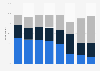
| Characteristic | Number of vacancies |
|---|---|
| Q3 2024 | 148,258 |
| Q2 2024 | 149,324 |
| Q1 2024 | 149,590 |
| Q4 2023 | 151,363 |
| Q3 2023 | 158,174 |
| Q2 2023 | 166,160 |
| Q1 2023 | 172,422 |
| Q4 2022 | 187,893 |
| Q3 2022 | 202,264 |
| Q2 2022 | 222,493 |
| Q1 2022 | 250,027 |
| Q4 2021 | 236,701 |
| Q3 2021 | 245,928 |
| Q2 2021 | 236,327 |
| Q1 2021 | 239,512 |
| Q4 2020 | 238,241 |
| Q3 2020 | 254,936 |
| Q2 2020 | 260,151 |
| Q1 2020 | 278,956 |
| Q4 2019 | 288,814 |
| Q3 2019 | 302,431 |
| Q2 2019 | 303,633 |
| Q1 2019 | 309,330 |
| Q4 2018 | 288,521 |
| Q3 2018 | 282,119 |
| Q2 2018 | 262,579 |
| Q1 2018 | 231,005 |
| Q4 2017 | 210,422 |
| Q3 2017 | 194,293 |
| Q2 2017 | 166,559 |
| Q1 2017 | 140,341 |
| Q4 2016 | 137,145 |
| Q3 2016 | 137,953 |
| Q2 2016 | 127,387 |
| Q1 2016 | 111,828 |
| Q4 2015 | 106,565 |
| Q3 2015 | 102,141 |
| Q2 2015 | 101,615 |
| Q1 2015 | 73,002 |
| Q4 2014 | 65,979 |
| Q3 2014 | 58,469 |
| Q2 2014 | 51,268 |
| Q1 2014 | 42,699 |
| Q4 2013 | 37,656 |
| Q3 2013 | 39,547 |
| Q2 2013 | 36,696 |
| Q1 2013 | 35,454 |
| Q4 2012 | 39,346 |
| Q3 2012 | 42,958 |
| Q2 2012 | 42,760 |
| Q1 2012 | 36,724 |
| Q4 2011 | 38,195 |
| Q3 2011 | 39,603 |
| Q2 2011 | 37,246 |
| Q1 2011 | 33,036 |
| Q4 2010 | 33,370 |
| Q3 2010 | 35,143 |
| Q2 2010 | 33,507 |
| Q1 2010 | 33,837 |
| Q4 2009 | 34,141 |
| Q3 2009 | 41,496 |
| Q2 2009 | 49,598 |
| Q1 2009 | 70,296 |
The chart is not accessible to screen readers. Please switch to the table view to access the data.
December 2024
Czechia
Q1 2009 to Q3 2024
Job vacancy statistics (JVS) provide information on the level and structure of labor demand. Eurostat publishes quarterly data on the number of job vacancies and the number of occupied posts which are collected under the JVS framework regulation and the two implementing regulations: the implementing regulation on the definition of a job vacancy, the reference dates for data collection, data transmission specifications and feasibility studies, as well as the implementing regulation on seasonal adjustment procedures and quality reports. Eurostat disseminates also the job vacancy rate which is calculated on the basis of the data provided by the countries.聽
According to Eurostat, a job vacancy is defined as a paid post that is newly created, unoccupied, or about to become vacant.
Eurostat also publishes the annual data which are calculated on the basis of the quarterly data.
The data for this statistic has been extracted from Eurostat using the Code JVS_Q_ISCO_R2