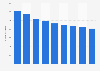
| Characteristic | Number of single parents in thousands |
|---|---|
| - | - |
| - | - |
| - | - |
| - | - |
| - | - |
| - | - |
| - | - |
| - | - |
| - | - |
| - | - |
| - | - |
| - | - |
| - | - |
| - | - |
| - | - |
| - | - |
| - | - |
| - | - |
| - | - |
| - | - |
| - | - |
| - | - |
| - | - |
| - | - |
| - | - |
| - | - |
| - | - |
| - | - |
| - | - |
The chart is not accessible to screen readers. Please switch to the table view to access the data.
May 2025
Germany
1996 to 2024
鹿 The comparability of the time series is limited due to the following methodological changes:
2024: Preliminary results
2021: Data from 2021 onwards are extrapolations using the population update based on the 2022 census.
2020: New version of the microcensus.
2016: from 2016 updated sample selection basis based on the 2011 census.
2011: Data from 2011 onwards are extrapolations using the population update based on the 2011 census.
2005: The Microcensus Act 2005 changed the microcensus from a survey with a fixed reporting week (until 2004 usually the last public holiday-free week in April) to a continuous survey with a rolling reporting week. According to the source, the results from 2005 onwards no longer provide a 鈥榮napshot鈥� of a specific calendar week, but provide information on the overall development on average over the survey year. The methodological changes associated with the introduction of the rolling reference week have so far led to fluctuations in the number of households, particularly single-person households and families/living arrangements.