U.S. President Donald Trump鈥檚 four-day trip to the Middle East last week included visits to Saudi Arabia, Qatar and the United Arab Emirates. The tour marked his first planned trip abroad of his second term in office, and is considered by analysts to reflect a shift in the United States鈥� approach to the region. For one, Trump notably did not meet with Israeli Prime Minister Benjamin Netanyahu, which writes is a 鈥渞eflection of the deteriorating ties鈥� between the two governments. While in Riyadh, Trump also announced that the U.S. would be lifting sanctions on Syria.
During the trip, Trump also announced several major deals with countries in the Middle East, including a defense sales agreement signed between the U.S. and Saudi Arabia for nearly $142 billion, which the has described as the largest arms deal ever. Other major deals included an agreement with Qatar that Qatar Airways would buy up to 210 passenger jets for $96 billion from the American manufacturer Boeing.
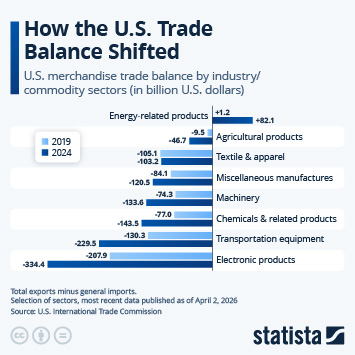
According to from the Office of the U.S. Trade Representative, total bilateral trade between the United States and countries in the Middle East and North Africa (MENA) amounted to an estimated $141.7 billion in 2024. Israel, the UAE and Saudi Arabia were the biggest trading partners, together accounting for 69 percent of MENA's trade. The U.S. goods trade surplus with the Middle East was $19.1 billion last year, marking a 39.8 percent increase from 2023.