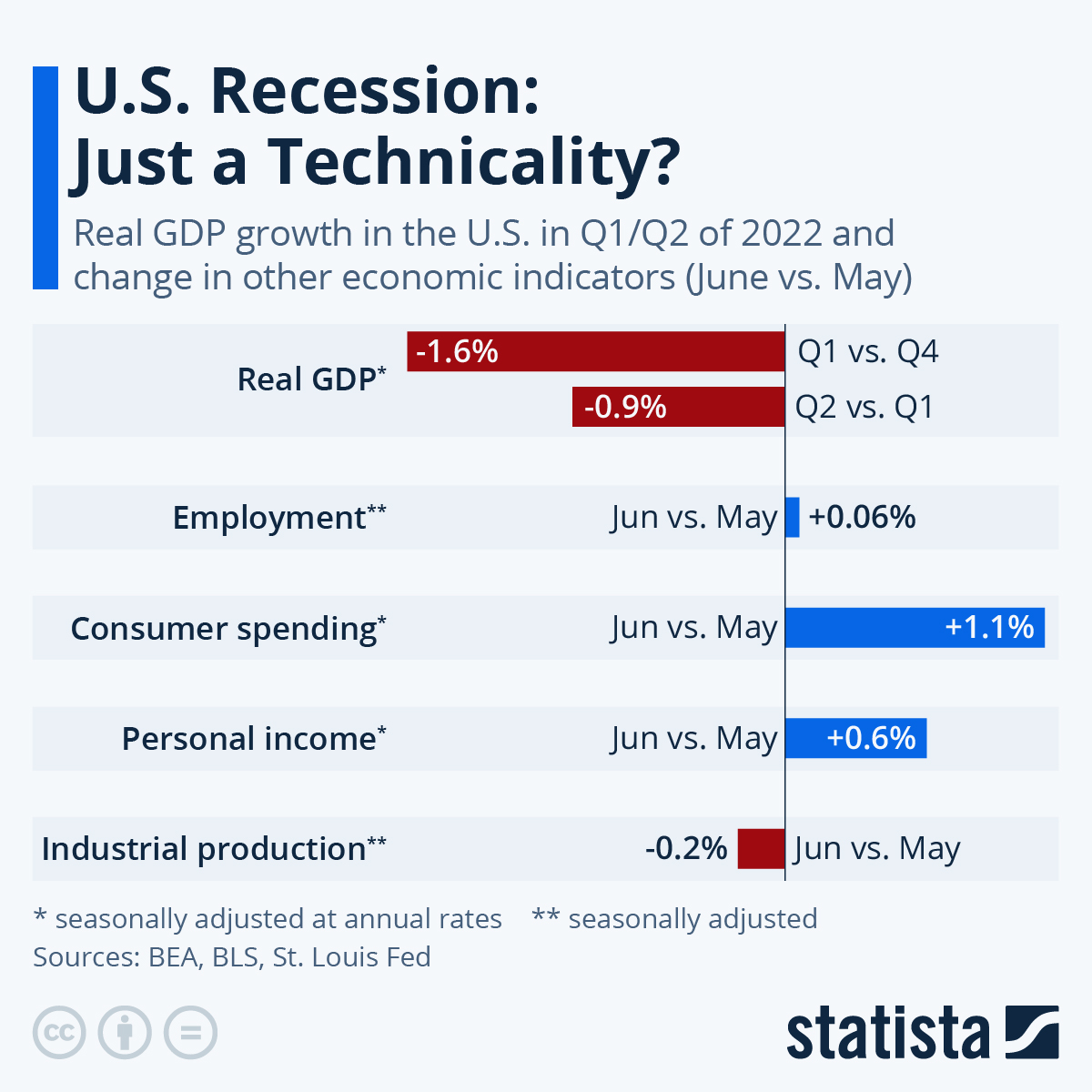
After the United States recorded two consecutive quarters of negative growth in Q1 and Q2 of 2022, the Biden administration was quick to point out that the development - even though it constitutes a widespread definition of recession - does not meet the
Government analysts might have a point, however, when alleging that a recession only happens when there is income, employment, consumption, sales and industrial production, and that the U.S. has not entered one officially until the National Bureau of Economic Research says so.
Of all the indicators mentioned above, only one signaled economic decline in June, the last month of the period in which the United States entered what is sometimes called a technical recession of two consecutive negative growth quarters. declined slightly by 0.2 percent compared to May 2022.
All the other indicators pointed towards expansion but saw only small gains. The slimmest was in , which increased by a seasonally adjusted 0.06 percent in June, causing the unemployment rate to stagnate at a still low 3.6 percent. The July figure, which has since been released saw another 0.07 added to seasonally adjusted employment, lowering unemployment to 3.5 percent.
Personal income grew slightly by 0.6% on a seasonally adjusted, annualized basisNevertheless, showed the strongest growth at 1.1% (and 0.1% after adjusting for inflation). Summing up, the current weird economy 鈥� 鈥� is a contradictory one where high inflation and economic contraction exist side by side. To enter 鈥� which is an economy that is most often brought about by adverse events 鈥� falling employment would have to be added.