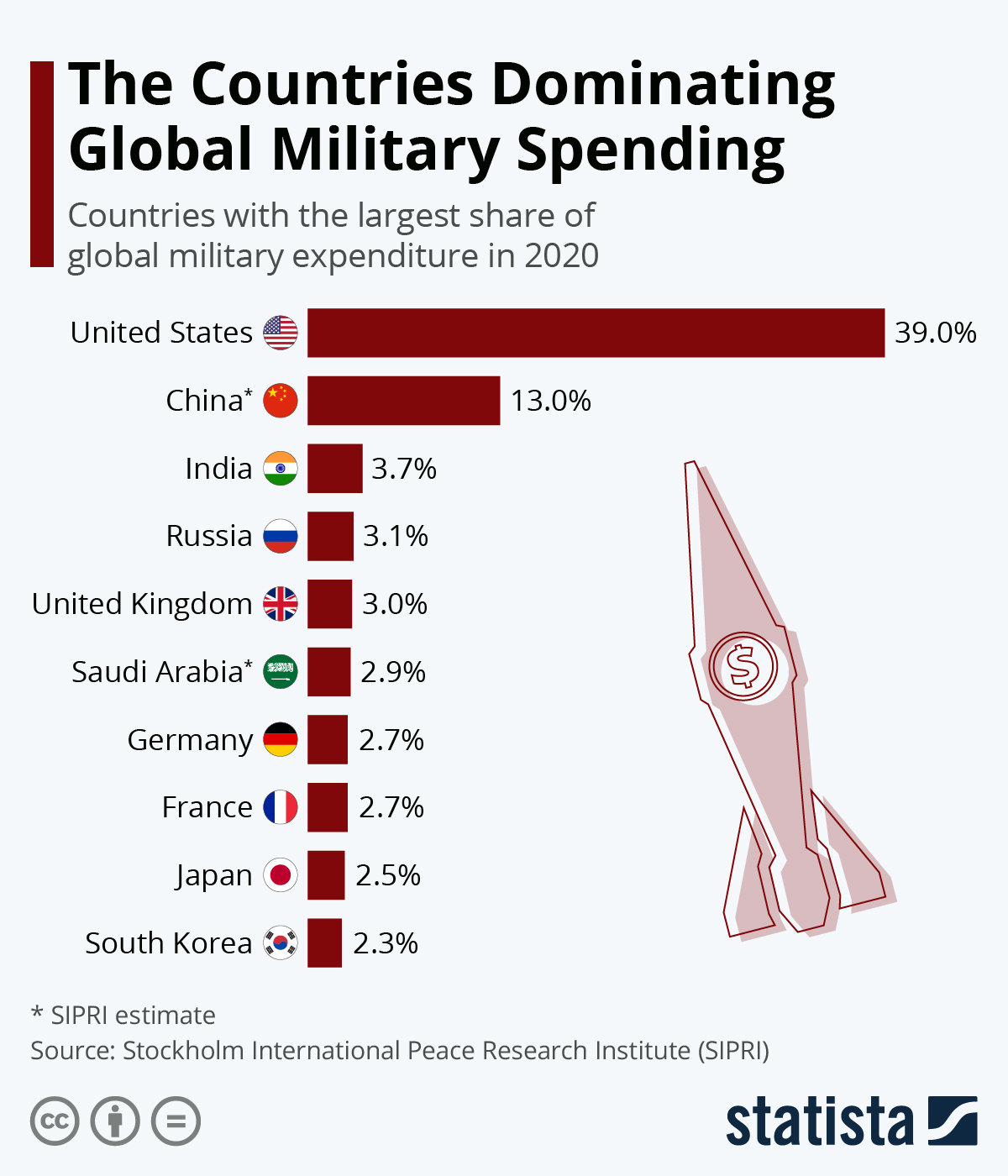
Together, China and the United States accounted for almost half of world military expenditure in 2024. The U.S. was the biggest defense spender, financing their military with $997 billion. This made up 37 percent of the world鈥檚 military spending. China came in second place with the equivalent of an estimated $314 billion, accounting for 12 percent of the global military budget.
China increased spending by 7 percent between 2023 and 2024. This was the country鈥檚 largest annual percentage increase since 2015 and the 30th consecutive year of growth. According to the SIPRI , China鈥檚 increased spending is part of a long-term goal to modernize its military by 2035. Last year, the country established both an aerospace and cyberspace force.
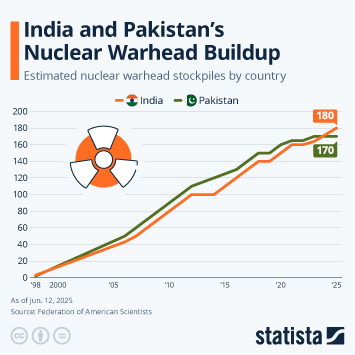
India, the world鈥檚 fifth biggest military spender, increased its spending by 1.6 percent between 2023 and 2024 to $86.1 billion, equating to 3.2 percent of world spending. The South Asian nation is currently one of the world鈥檚 biggest importers of weapons and is now moving to become more independent by funding domestic procurement.
In 10th and 11th positions come Japan and South Korea with $55.3 billion and $47.6 billion of military investment, respectively, following France in rank 9 with $64.7 billion. Meanwhile, Taiwan upped its military spending by 1.8 percent to $16.5 billion, as it has continued to buy U.S.-made weapons and to develop domestic systems.
Speaking on the topic, Nan Tian, Director of the SIPRI Military Expenditure and Arms Production Programme, highlighted the risk of an escalation in Asia: 鈥淢ajor military spenders in the Asia鈥揚acific region are investing increasing resources into advanced military capabilities,鈥� he said. 鈥淲ith several unresolved disputes and mounting tensions, these investments risk sending the region into a dangerous arms-race spiral.鈥�