As the world continues to battle the Covid-19 pandemic, it remains underprepared for future epidemics and pandemics, according to new research. No country reached the highest category of preparedness for future health emergencies on the , a joint project of the Nuclear Threat Initiative (NTI), the Johns Hopkins Center for Health Security at the Bloomberg School of Public Health and Economist Impact.
The index, which has been revised to reflect experience from the Covid-19 pandemic, focuses on six aspects of a country鈥檚 preparedness: prevention, detection and reporting, rapid response, health systems, compliance with international norms, and risk environment. 鈥淭he response to Covid-19 has shown that many factors鈥攊ncluding public health and healthcare capacities, scientific understanding and countermeasure distribution, and social and economic resilience鈥攑lay a pivotal role in how countries are able to respond during a pandemic,鈥� the report鈥檚 website says.
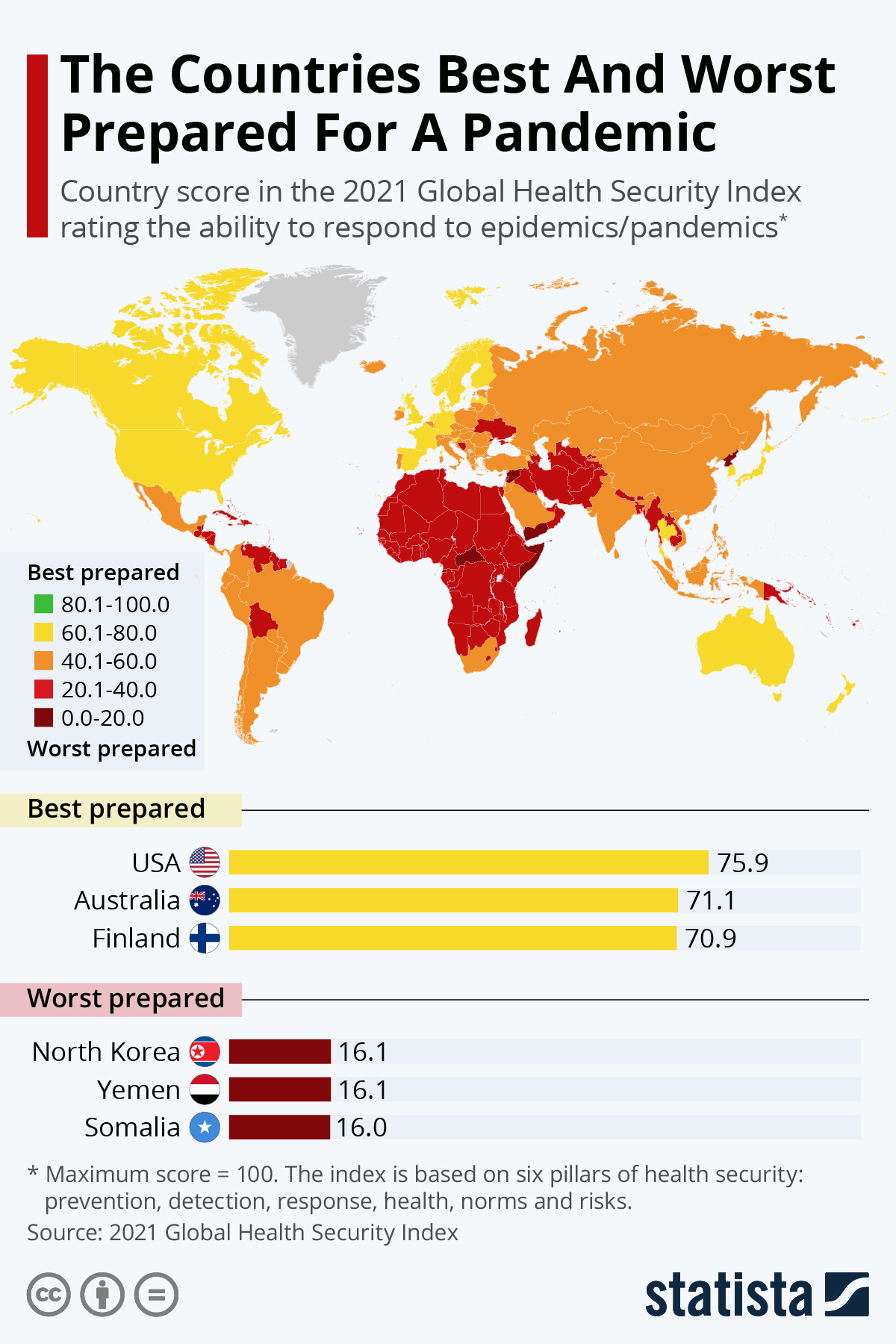
The 2021 edition of the index finds that despite Covid-19 having raised awareness of the threat of previously unknown pathogens emerging, 鈥渁ll countries remain dangerously unprepared to meet future epidemic and pandemic threats.鈥� The average country score in 2021 was 38.9 out of 100, which is marginally worse than the 2019 result of 40.2 out of 100. The fact that even the 鈥渂est prepared鈥� countries do not reach the top tier of the GHS Index signals that 鈥渟ignificant gaps exist for all countries and across categories,鈥� leaving preparedness 鈥渇undamentally weak at all country income levels.鈥�
As the following chart shows, the United States once again achieved the highest overall score at just under 76, which is still far off the mark. Interesting sidebar: Back in February 2020, President Trump (and a previous version of this infographic) at a press briefing to assure the public of his country鈥檚 preparedness for what was to come. And while the U.S. did score best in that ranking, the main takeaway from the report was discouraging. In October 2019, found that 鈥渘o country is fully prepared for epidemics or pandemics. Collectively, international preparedness is weak. Many countries do not show evidence of the health security capacities and capabilities that are needed to prevent, detect, and respond to significant infectious disease outbreaks.鈥� Two months later, the novel coronavirus would put the world鈥檚 preparedness to the test.