On Friday, Ireland will hold a referendum to decide whether blasphemy should be decriminalised. As of today, the Irish Constitution states that 鈥淭he publication or utterance of blasphemous, seditious, or indecent matter is an offence which shall be punishable in accordance with law.鈥� Although there has been no actual prosecution for blasphemy since 1855, its opponents say that its inclusion in the Constitution amounts to a restriction on the freedom of expression. Liam Herrick, director of the Irish Council for Civil Liberties issued a on Monday in which he said: "Criminalising blasphemy has no place in a modern democracy such as ours. Irish people don鈥檛 want criminal prosecution for those who call into question the authority of religious teachings".
The Irish Catholic Church has also that the reference to blasphemy in the Constitution is 鈥渓argely obsolete", adding that it "may give rise to concern because of the way such measures have been used to justify violence and oppression against minorities in other parts of the world鈥�. Qualifying this however, it was also noted that the right of people to practise their faith without being subjected to attack or ridicule 鈥渘eeds to be acknowledged and respected鈥�.
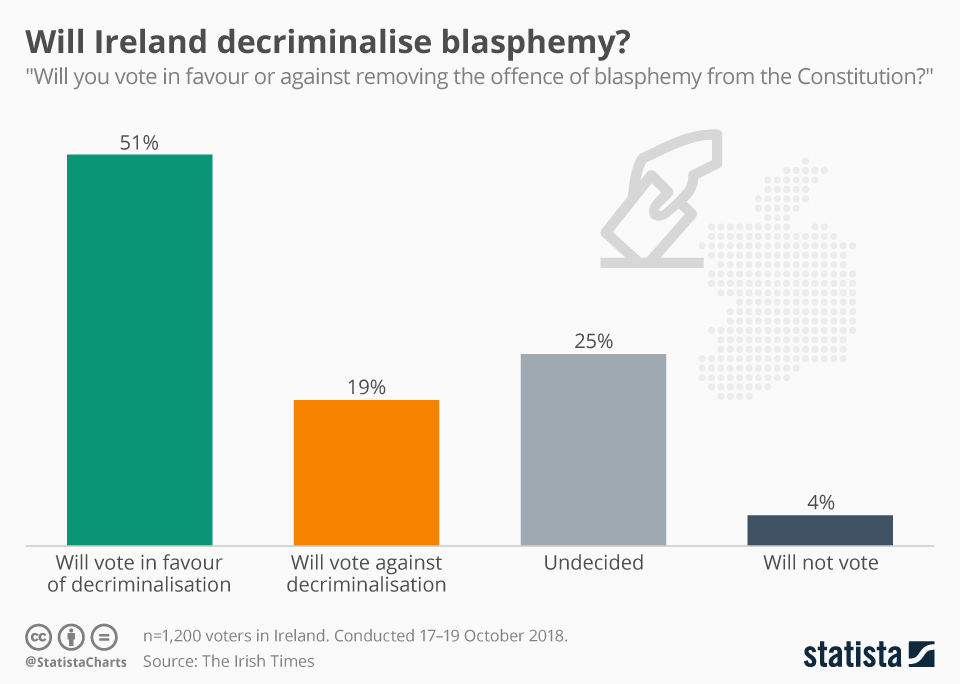
The law was brought most recently into the spotlight when Stephen Fry, speaking on Irish television, described God as "mean-minded" and an "utter maniac". While the investigation was eventually dropped due to an apparent lack of people that had been outraged, the case has arguably led to tomorrow's referendum to some degree. The vote is to be combined with the presidential election and, according to a new by The Irish Times, a majority of voters are likely to vote in favour of decriminalisation.
Referendum
Will Ireland decriminalise blasphemy?

Description
This chart shows the voting intention for the blasphemy referendum in Ireland in 2018.